
Breakout Bulletin | March 27, 2026 |
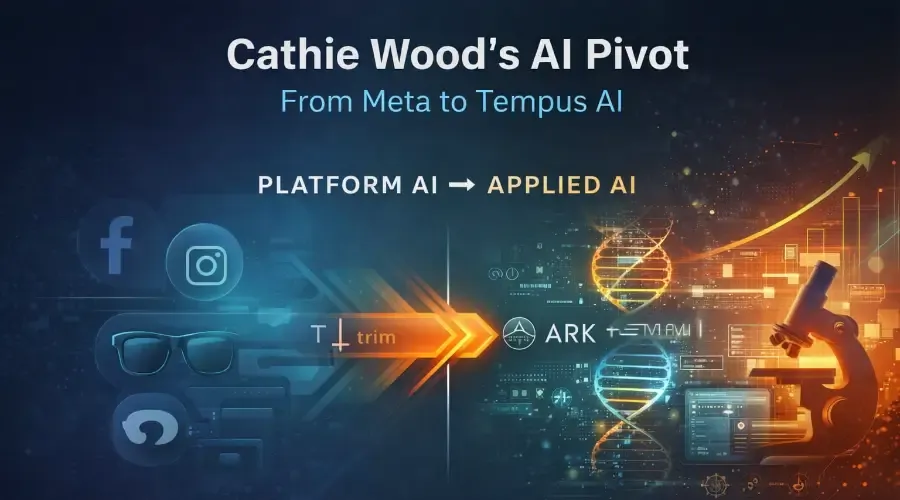
ARK Invest’s latest portfolio moves signal a clear shift in AI positioning. Cathie Wood trimmed exposure to Meta (META) and Roku (ROKU) while significantly increasing allocation to Tempus AI (TEM). The move highlights what appears to be a regime change in AI investing-shifting from platform “enablers” to applied, industry-specific AI companies.
In practical terms, this is not just a trade-it is a statement on where ARK believes the next phase of AI-driven returns may emerge.
The Trades: What ARK Actually Did
ARK’s transactions over March 25–26 show a clear reallocation. The fund sold Meta shares across ARKK and ARKW, reduced Roku exposure across multiple ETFs, and added significantly to Tempus AI, lifting it into a top position.
Quantitatively, Tempus AI now represents approximately 4.3% of ARKK, up from around 1.8% at the start of March, while Meta’s weight has fallen from roughly 3% to under 0.5%. The implication is clear: this is a portfolio-level shift, not a tactical adjustment.
Why Meta and Roku Were Trimmed
Meta: From Scale to Saturation Concerns
Meta remains a dominant AI platform player, but several factors likely influenced ARK’s reduced exposure. These include regulatory overhang across US and European markets, execution risks tied to hardware initiatives like smart glasses, and a broader shift in perception from high-growth disruptor to mature platform.
That shift matters because ARK prioritizes asymmetric upside, and with Meta’s market cap already exceeding $1.5 trillion, the probability of outsized returns is structurally lower than in earlier-stage companies.
Roku: Cyclical Pressure in Streaming
Roku’s business model remains tied to advertising cycles, making it sensitive to macro conditions. At the same time, competition from Amazon and Apple ecosystems has reduced its differentiation.
This suggests a broader pattern: ARK is reducing exposure to maturing digital platforms and reallocating toward emerging AI-driven verticals.
The Core Bet: Why Tempus AI
Tempus AI operates at the intersection of healthcare and artificial intelligence, using clinical and molecular data to improve diagnostics and drug discovery. Its platform is already used by over 70% of US academic medical centers and hundreds of biopharma firms.
ARK’s increased allocation reflects three key themes. First, specialized AI advantage, where healthcare AI operates in high-barrier, data-rich environments with strong defensibility. Second, undervalued growth potential, as ARK continues to buy into disruptive companies during pullbacks. Third, expanding total addressable market, with precision oncology alone projected to exceed $150 billion annually by 2030.
In practical terms, ARK is shifting toward AI models where monetization is tied to outcomes (clinical, pharmaceutical) rather than engagement (ads, users).
A Critical Look at Tempus AI
While the thesis is compelling, the fundamentals warrant scrutiny. Tempus reported approximately $180 million in Q4 2025 revenue, growing 28% year-over-year, but remains unprofitable with negative free cash flow. The company held roughly $420 million in cash, providing limited runway depending on burn rates.
Competition is intensifying, with players like Foundation Medicine (Roche), Guardant Health, and emerging partnerships from large tech firms entering healthcare AI.
From a valuation perspective, Tempus trades at roughly 8x forward revenue, which sits above traditional biotech multiples but below high-growth SaaS AI peers, placing it in a hybrid valuation zone that reflects both opportunity and risk.
The Bigger Pattern: ARK’s 2026 Rotation
This move aligns with ARK’s broader strategy. The firm has been reducing megacap exposure, increasing allocation to pure-play AI companies, and focusing on niche, high-growth subsectors.
The implication is that broad AI winners may already be partially priced in, while sector-specific AI opportunities remain underappreciated.
A Note on ARK’s Track Record
ARK’s history is mixed. While it has delivered significant winners such as Tesla and Exact Sciences, it has also experienced drawdowns in names like Teladoc and Zoom, particularly during the post-2021 correction.
This context matters because it reinforces that high-conviction positioning does not guarantee outcomes.
Market Reaction and Positioning
Following the trades, Tempus AI saw increased trading activity and modest price gains, while Meta and Roku showed relatively muted reactions.
This highlights an important dynamic: ARK flows tend to have a greater impact on smaller-cap, less liquid names, reinforcing short-term momentum in those stocks.
Risks to the Thesis
Despite strong conviction, several risks remain. These include execution risk in healthcare AI, regulatory complexity in medical data, valuation sensitivity in early-stage companies, and potential ARK fund outflows that could force rebalancing.
These risks underscore the gap between thematic potential and realized performance.
Structural Takeaway
In practical terms, ARK’s rotation signals a deeper shift in how AI is being valued. The market may be transitioning from platform-driven AI narratives to outcome-driven AI models, where value is created through specific industry applications rather than scale alone.
If this shift holds, specialized AI companies could attract increasing capital flows, while large-cap platforms may see more balanced expectations.
The key question is whether this represents a true market transition-or simply ARK’s high-conviction style playing out once again.
What to Watch Next
Watch whether ARK continues to add to Tempus AI, upcoming earnings and operational updates, broader flows into healthcare AI, and whether other institutions begin rotating into similar vertical AI themes.
These signals will determine whether this move evolves into a broader market trend or remains a fund-specific positioning shift.
FAQ
Why is ARK Invest selling Meta to buy Tempus AI?
ARK appears to be shifting from platform AI to applied AI, where growth is driven by industry-specific outcomes rather than user engagement. Meta represents scale, while Tempus represents asymmetric upside in a specialized domain.
What makes Tempus AI a high-conviction bet?
Tempus owns one of the largest clinical and molecular datasets globally, giving it a potential moat in healthcare AI. Its model ties AI directly to diagnostic and treatment outcomes, which may offer more durable monetization.
Does this mean megacap AI is over?
Not necessarily. It suggests that megacap AI may be partially priced in, while investors like ARK are seeking higher-growth opportunities in niche AI verticals.