
Broadcom Drops 12% on an Earnings Beat: Decoding the Institutional "Whisper Number" Disconnect

Broadcom ($AVGO) beat top and bottom-line Q2 consensus, yet the stock shed 12%. We look past the headlines to analyze the underlying Q3 AI guidance shortfall.

Broadcom Drops 12% on an Earnings Beat: Decoding the Institutional "Whisper Number" Disconnect

Published: June 4, 2026 | Category: Earnings Post-Mortem | Read time: 6 min

All figures in this post are based on publicly available earnings release data and analyst commentary as of June 3–4, 2026. Actual outcomes can differ materially from any modelled scenario.

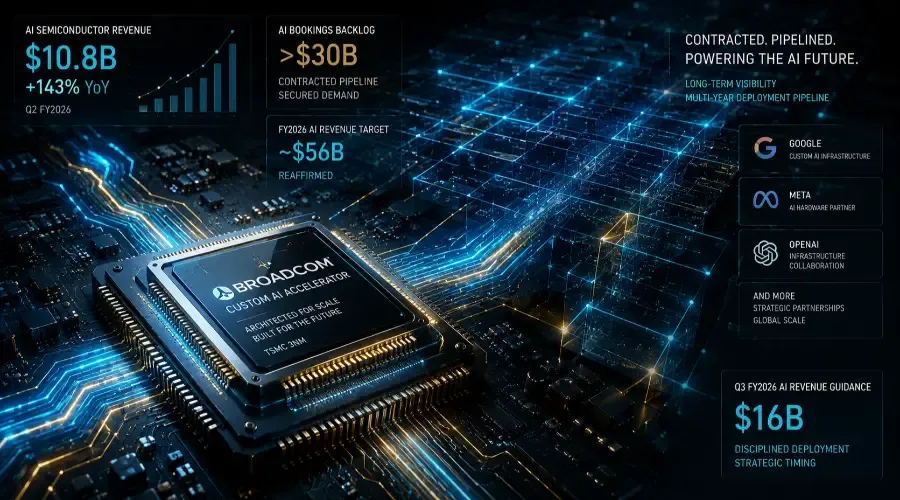
Broadcom ($AVGO) reported Q2 FY2026 earnings on June 3 and beat on every headline metric. Non-GAAP EPS came in at $2.44 against a $2.40 consensus. Revenue hit $22.19B, up 48% year-over-year. AI semiconductor revenue reached $10.8B, up 143% year-over-year.

The stock dropped over 12% in after-hours and early trading.

Understanding why a company that beat on every visible metric gets sold down 12% requires looking at the number that was not in the headline – the institutional AI revenue consensus for Q3, and how the actual Q3 guidance compared to it. But the full picture also requires a look at what CEO Hock Tan revealed about the bookings backlog, because that data point shifts the narrative from “is demand cracking?” to “this is a scheduling gap.”

The verified numbers

Metric Verified figure Source
Q2 FY2026 revenue $22.19B (+48% YoY) Company earnings release
Q2 non-GAAP EPS $2.44 vs $2.40 consensus Company earnings release
Q2 AI semiconductor revenue $10.8B (+143% YoY) Company earnings release
Q2 semiconductor solutions revenue $15B (+79% YoY) Company earnings release
Q3 FY2026 total revenue guidance $29.4B (+84% YoY) Company earnings release
Q3 AI semiconductor revenue guidance $16B Company earnings release
Q3 institutional AI revenue consensus ~$16.36B Visible Alpha analyst consensus
Q3 AI guidance vs consensus -$360M below consensus Derived from above figures
AI semiconductor bookings backlog Crossed $30B Hock Tan, earnings call
FY2026 AI revenue target (reaffirmed) ~$56B Management commentary, earnings call
2027 AI chip revenue target >$100B Q1 FY2026 earnings call, Hock Tan

Visible Alpha consensus aggregates sell-side analyst estimates at a segment level, often more granular than headline consensus figures.

Why a beat turned into a 12% drop

The Q2 numbers were genuinely strong. A 143% year-over-year increase in AI semiconductor revenue and a 48% overall revenue growth rate are not modest figures. Beyond the AI engine, Broadcom’s infrastructure software and traditional networking businesses contributed steadily, providing a diversified earnings base that often gets overlooked when AI dominates the narrative. GAAP results also reflected the weight of acquisition-related amortisation from the VMware deal, but the underlying cash generation remained robust – an important backstop when multiples are under pressure.

The headline beat was real. The problem was what management guided for Q3.

Broadcom guided Q3 AI semiconductor revenue at $16B. The institutional consensus tracked by Visible Alpha was approximately $16.36B. That $360M shortfall – roughly 2.2% below what the street was expecting – was enough to trigger a significant repricing of the stock.

This is the whisper number dynamic in practice. The visible consensus EPS and revenue figures are what get reported in the headlines. But institutional investors also track segment-level expectations – in Broadcom’s case, the AI chip revenue figure specifically. When that segment guides below what institutional models had built in, the repricing can be disproportionate to the absolute size of the miss because the AI revenue trajectory is the primary driver of the valuation multiple.

The expectation reset vs thesis damage question

The critical distinction for anyone holding or watching $AVGO is whether this is an expectation reset or genuine thesis damage. The new data from the call tilts the balance heavily in one direction.

The case for expectation reset – now the dominant interpretation:

Broadcom’s contracted AI pipeline with Google, Meta, and OpenAI remains intact based on publicly disclosed partnership agreements. But the most powerful defensive data point came directly from Hock Tan on the call: the AI semiconductor bookings backlog has officially crossed $30 billion.

A $30B+ backlog means the $360M Q3 guidance miss is not a demand problem. It is a supply-chain and deployment schedule boundary. The revenue is contracted – hyperscalers have committed to these orders. The timing of when they take delivery is what creates quarter-to-quarter variability. Management also reaffirmed the full-year FY2026 AI revenue target of approximately $56 billion, which means the company still expects to hit the annual number even with a slightly lighter Q3 guide. That directly implies a back-half-loaded revenue ramp, which is entirely consistent with how custom ASIC programmes unfold.

The case for thesis damage – now materially weakened:

Before the backlog disclosure, a reasonable concern was that the market was pricing in a growth trajectory that $16B did not confirm. At roughly 37x forward earnings before the print, any miss on the segment that drives the multiple could trigger compression because the valuation leaves no room for deceleration. The 12% drop from ~37x forward earnings implies a post-selloff multiple in the neighbourhood of 32–33x, all else equal – still a premium, but one that may look more proportionate against a $30B bookings backlog and a reaffirmed $56B annual target.

The bear case now rests on execution risk: can the company convert the backlog into recognised revenue on the timeline the market expects? That is a scheduling risk, not a demand risk. The thesis isn’t broken; the timeline has become the variable.

The math that determines whether $AVGO recovers

If Broadcom needs to reach more than $100B in AI chip revenue in 2027, and Q3 is guiding $16B, a simple quarterly run-rate calculation frames the challenge.

Four quarters at $16B would produce $64B annually – well below $100B. But that linear extrapolation ignores what the bookings backlog now makes explicit: custom ASIC rollouts are inherently lumpy, and the contracted revenue is back-half loaded. A $30B+ backlog alongside a reaffirmed $56B FY2026 target means the production ramp is expected to steepen significantly in the second half of this year and into 2027. Hyperscaler deployment schedules, not demand, dictate the shape of that curve.

To reach $100B+ in 2027, the quarterly AI revenue run rate still needs to accelerate meaningfully from the $16B level. Management’s implied trajectory requires that ramp, and the backlog gives them a contractual foundation to point to. It is a trajectory the market will scrutinise closely at every quarterly print between now and 2027, but the numbers now contain a margin of safety that was not visible before the call.

Three things to monitor

1. Q4 FY2026 AI revenue guidance

This arrives with Q3 results. If Q4 guidance accelerates above $18B–$20B, the ramp toward the 2027 target looks credible. If Q4 guidance is in the $16B–$17B range, the 2027 target still requires a very steep step-up – but with the $30B backlog, even a flat guide would be interpreted as a timing issue rather than a demand shortfall.

2. Hyperscaler capex commentary

Google, Meta, and Microsoft all report quarterly results with AI infrastructure spending commentary. Any acceleration in their capex plans directly supports Broadcom’s custom ASIC pipeline and the conversion of backlog into revenue. Any deceleration would be worth watching, but the contractual commitments in the backlog soften the blow – hyperscalers can delay deliveries, but they can’t easily walk away from signed custom silicon programmes.

3. Multiple compression stabilisation

Before the print, $AVGO was trading at roughly 37x forward earnings. The 12% drop implies a multiple closer to 32–33x, though the exact figure depends on forward estimates post-guidance. Where the stock stabilises relative to forward earnings will tell you what multiple the market is now willing to pay for a growth trajectory backed by a $30B+ backlog. If the multiple holds in the low 30s, the repricing is likely done. If it drifts lower, the market is pricing in a longer timeline for that backlog to convert.

What this means in practical terms

If you were long going into earnings: The thesis has actually strengthened – the $30B bookings backlog and reaffirmed $56B FY2026 target are significant positive data points that were not priced in before the print. The 12% drop was a reaction to a single quarterly guide, not a demand signal. The question is whether the current price fully reflects that backlog or whether the market needs a quarter or two of execution to regain confidence.

If you are watching from the sidelines: The 12% drop and the backlog disclosure together create a materially different entry setup than existed before earnings. You now have a contracted revenue cushion that was not visible at the $400+ price level. The risk is timing, not demand, which is a lower-quality risk. Q3 results and Q4 guidance remain the confirmation points, but the downside scenario has been substantially cushioned by the backlog.

If you track the AI infrastructure theme broadly: The $360M miss against institutional consensus on a 143% growth segment – and the market’s 12% reaction – tells you expectations for AI chip demand growth have run well ahead of even strong actual delivery. But the $30B backlog also tells you the demand is real; it’s just arriving on a schedule that institutional models haven’t fully calibrated. That dynamic likely affects how every AI infrastructure name trades around earnings until production ramps catch up with the models.

FAQ

Why did Broadcom stock drop after beating earnings?

The company beat on headline EPS and revenue, but guided Q3 AI semiconductor revenue to $16B, about $360 million below the institutional consensus of ~$16.36B. The AI segment is the primary valuation driver, so even a small miss on that number triggered a significant repricing.

What is a bookings backlog and why does it matter?

A bookings backlog represents contracted orders that have not yet been recognised as revenue. Broadcom’s AI backlog crossing $30B means that hyperscaler demand is legally committed – the revenue will flow through as customers take delivery, smoothing out quarter-to-quarter variability.

Is the 2027 $100B+ AI revenue target still realistic?

Management maintained the target and backed it up with a $30B+ backlog and a reaffirmed $56B FY2026 AI revenue forecast. The quarterly ramp still needs to steepen, but the backlog provides a contractual pathway that makes the target more credible than a simple run-rate extrapolation would suggest.

What should I watch next?

The key data points are Q4 AI revenue guidance (released with Q3 results), hyperscaler capex commentary from companies like Google and Microsoft, and where Broadcom’s forward P/E multiple stabilises after the selloff. A Q4 guide above $18B would strongly support the acceleration thesis.

This analysis is for educational purposes only and does not constitute investment advice. All figures are based on Broadcom’s Q2 FY2026 earnings release, publicly available analyst consensus data, and management commentary as of June 3–4, 2026. The $16.36B institutional AI revenue consensus figure is sourced from Visible Alpha analyst tracking. The 2027 AI chip revenue target of more than $100B and the $30B+ bookings backlog are attributed to Hock Tan’s commentary on the earnings call. Valuation multiples are approximate. Please consult a qualified financial advisor before making investment decisions. BreakoutBulletin does not hold positions in any securities mentioned.