
| Metric | Verified figure | Source |
|---|---|---|
| Brent crude latest | ~$97–$98/barrel | CME / Yahoo Finance, June 3 2026 |
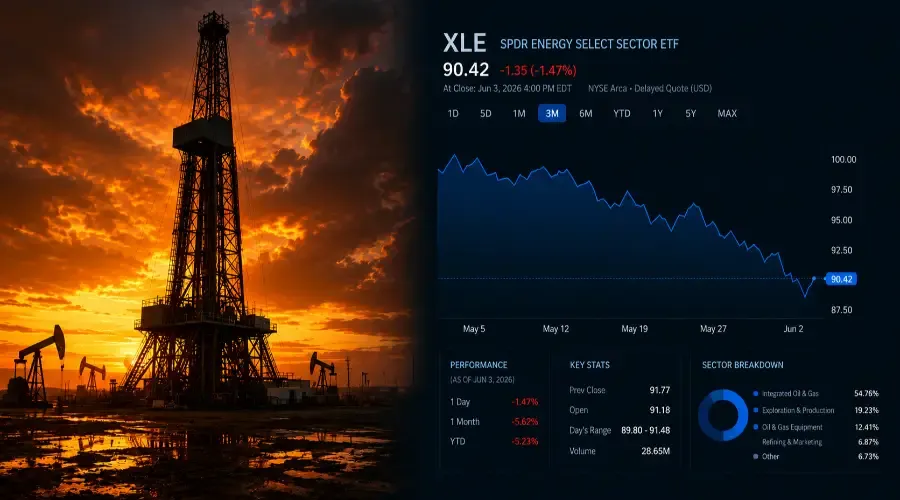
| XLE price | ~$58.97–$59.23 | MarketChameleon / INDmoney, June 3–4 2026 |
| XLE 3-month return | ~+4.1% | MarketChameleon, June 3 2026 |
| SPY 3-month return | ~+10.3% | MarketChameleon, June 3 2026 |
| 3-month performance gap | ~6.2 percentage points | Derived from above |
| XLE 2-week return | ~-3.8% | MarketChameleon, June 3 2026 |
| SPY 2-week return | ~+2.9% | MarketChameleon, June 3 2026 |
Note: A separate source showed XLE 3-month return at approximately +2.55% as of June 4. The figures above use the MarketChameleon direct comparison as it provides both XLE and SPY on the same timeframe. The direction of underperformance is consistent across both sources.
What the divergence may mean
When crude holds near $97 but energy equities underperform the broader market, multiple forces can contribute simultaneously. They aren’t competing explanations; they often reinforce each other.
Force 1 – Price durability skepticism.
The equity market may not fully believe the $97 crude level is durable. Geopolitical risk premiums can push spot prices higher without the market treating that level as a structural floor. If institutional capital views the current crude price as a temporary premium rather than a reflection of persistent supply-demand tightness, energy equities may not receive meaningful new allocation even at these oil price levels.
Force 2 – Margin absorption.
Energy producers in the current cycle may be facing higher labour, equipment, and capital expenditure costs than in prior oil cycles. If a larger share of the revenue gain from $97 crude is being consumed by operating costs, the earnings leverage that typically makes energy equities attractive at high crude prices may be structurally lower than historical patterns suggest.
If both forces are at work – the market doubts the crude price will last, and producers are retaining less of each revenue dollar – that would help explain why XLE has underperformed SPY by roughly 6.2 percentage points while oil trades near $97. For context, in the 2022 oil rally, XLE outperformed SPY by roughly 40 percentage points over a comparable timeframe with crude above $90. The equity market confirmed the commodity signal almost immediately. That kind of confirmation is absent right now.
The line in the sand
The key indicator to watch is the XLE/SPY relative strength ratio – a line that simply divides XLE’s price performance by SPY’s. When that ratio trends downward while the underlying commodity (crude oil) stays elevated or rises, it forms a classic bearish divergence. Historically, this type of divergence has more often preceded a correction in the commodity itself than a catch-up rally in the equities.
Watch whether this ratio begins to turn upward – meaning XLE starts outperforming SPY on a rolling 5-session basis – while Brent holds above $95. That convergence would be the first sign that institutional capital is beginning to price in a more durable oil environment.
Until that convergence appears, buying $XLE based solely on the crude price headline carries the risk that the equity market has already assessed the situation and chosen not to act. The 2-week data reinforces this caution: XLE declined -3.8% while SPY gained +2.9%, showing that near-term momentum in energy equities is running counter to the commodity price direction.
The Breakout Rule: Never long an equity sector purely because its underlying commodity is spiking if the relative strength ratio against the S&P 500 is printing lower highs. The equity tape almost always sniffs out an unsustainable commodity rally before the spot market does.
Three things to monitor
1. XLE vs SPY on a rolling 5-session basis
Is the 6.2 percentage point 3-month gap narrowing or widening? Narrowing while crude holds above $95 is the convergence signal. Widening suggests the divergence is deepening.
2. Brent crude futures curve
Is the market pricing current levels as durable or is the futures curve in backwardation – meaning near-term contracts price higher than longer-dated ones? Backwardation often signals the market views the current price as temporary.
3. Energy sector earnings commentary on cost structure
The next wave of energy company earnings calls will include commentary on labour costs, equipment costs, and capital expenditure. If management teams are describing margin pressure despite high crude, that confirms the margin absorption force is a significant factor.
What this means in practical terms
If you are considering a long $XLE position: The crude price headline and the equity performance data are not aligned. That misalignment does not mean the trade is wrong – it means the trade requires a specific thesis about why the divergence will close, not just that crude is high. A long XLE position makes more sense when either the futures curve shifts to signal durability or energy earnings confirm margin expansion alongside elevated crude. Until one of those data points arrives, the crude price headline alone is not a sufficient thesis.
If you already hold $XLE: The 2-week -3.8% while SPY gained +2.9% is worth noting as near-term momentum context. The 5-session rolling relative strength ratio versus SPY is your ongoing signal to watch.
If you are tracking macro setups: The $97 crude and the XLE underperformance together represent a useful data point about whether commodity price strength is translating into equity earnings power in this cycle. That question will be answered through energy sector earnings over the next two quarters.
FAQ
What is the XLE/SPY relative strength ratio and why does it matter?
It’s a simple comparison: XLE’s price performance divided by SPY’s. If the line is rising, energy stocks are outperforming the broader market; if it’s falling, they’re lagging. When crude oil prices are high but this ratio is declining, it often signals that equity investors are skeptical the oil price will stick. Historically, this bearish divergence has tended to foreshadow a pullback in crude itself rather than a belated rally in energy stocks.
Could the divergence just be temporary before energy stocks catch up?
It’s possible. If the XLE/SPY ratio starts climbing while oil remains above $95, that would be the catch-up signal. But right now the 2-week numbers show XLE down nearly 4% while the S&P 500 is up almost 3% – the momentum is not on energy’s side. Waiting for the ratio to turn higher is a way to let the market confirm the trade rather than betting on a reversal that hasn’t started yet.
How do I check the Brent crude futures curve?
You can find it on exchanges like CME Group’s website or financial data platforms under Brent crude futures. Look at the prices for contracts expiring in different months. If the nearest month is the most expensive and prices fall off for later months, that’s backwardation – a sign the market thinks current high prices are temporary. If later months are priced higher, that suggests the market expects prices to remain elevated or even rise, which would be more supportive for energy equities.
This analysis is for educational purposes only and does not constitute investment advice. Performance figures are sourced from MarketChameleon and INDmoney as of June 3–4, 2026 and are approximations. A separate source showed XLE 3-month return at approximately +2.55% – the direction of underperformance is consistent across both sources. Brent crude figures reflect CME nearby futures settlement data. Please consult a qualified financial advisor before making investment decisions. BreakoutBulletin does not hold positions in any securities mentioned.