
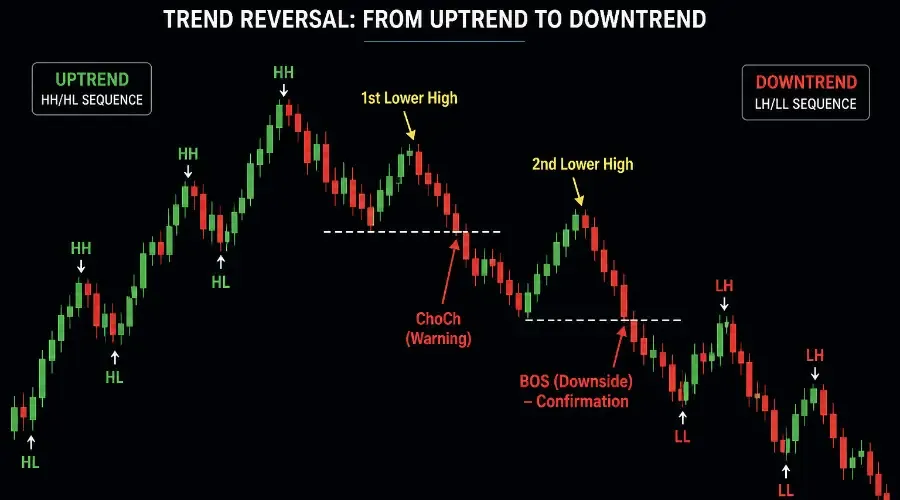
Identifying a trend is straightforward once you get the hang of the HH/HL and LH/LL framework. But the real skill – the one that separates traders who actually understand structure from those who just label charts – is knowing when a trend is ending. And more importantly, distinguishing a genuine structural shift from a temporary disruption.
Two concepts sit at the center of this problem: Break of Structure (BOS) and Change of Character (ChoCh). These terms show up constantly in price action and Smart Money Concepts (SMC) circles. But they’re often explained poorly – either too vague to be useful, or buried under so much jargon that the logic gets lost.
This post strips it back to the structural mechanics. What exactly counts as a break of structure? What is a change of character, and how is it different? Which one actually matters more? And how do these ideas connect to the rest of the structure series on BreakoutBulletin?
This is post five in the structure cluster. The prerequisite reading is the post on swing highs and swing lows – you need to be able to identify swing points accurately before BOS and ChoCh become useful analytical tools. The posts on higher highs and higher lows and lower highs and lower lows establish the trend structure context these concepts operate within.
Disclosure: Nothing on this page constitutes a recommendation to take any position in any security. Always consult a SEBI-registered investment advisor.
The Core Problem: Trends Do Not Announce Their Endings
In an uptrend defined by HH/HL sequence, the sequence works until it stops working. But the chart does not flash a signal when the last higher high has been made. Price just starts behaving differently – rallies get shorter, pullbacks get deeper, a prior swing low gets violated. The structural shift happens gradually, and by the time it is unambiguous, a significant portion of the move has already occurred.
BOS and ChoCh are frameworks for reading that shift as it develops – for identifying structural events that suggest the balance of the trend is changing, rather than waiting for the trend to be obviously over before acknowledging it.
What Is a Break of Structure (BOS)?
A Break of Structure occurs when price violates a significant swing point in the direction of the prevailing trend.
In an uptrend, a BOS occurs when price breaks above the most recent significant swing high – continuing and confirming the uptrend. In a downtrend, a BOS occurs when price breaks below the most recent significant swing low – continuing and confirming the downtrend.
By this definition, a BOS is not a reversal signal. It is a trend continuation signal. It confirms that the existing structure is intact and the trend is extending.
For example: in a HH/HL uptrend, after each pullback creates a higher low, the subsequent rally breaking above the prior swing high is a BOS to the upside. It confirms the uptrend structure is still valid and the market has made a new structural high.
Here’s what trips people up. The term "break of structure" sounds alarming – as if structure is being damaged. In some educational frameworks, that’s exactly how it’s used. But in its most precise form, a BOS simply means a significant swing point has been breached. The direction of the breach relative to the prevailing trend tells you whether it is a continuation event or the beginning of a reversal.
Visual Example: BOS in an Uptrend
[CHART: Uptrend with HH/HL. A red arrow points to a rally breaking above the previous swing high – labeled "BOS (Continuation)". The subsequent HH and new HL are marked.]
In an uptrend, price breaking above the most recent swing high confirms the trend continues.
BOS in a Downtrend
In a LH/LL downtrend, each successive swing high is lower than the last. When price rallies and then breaks below the prior swing low, that is a BOS to the downside – confirming the downtrend continues. The structure is intact.
[CHART: Downtrend with LH/LL. A red arrow points to a move breaking below the most recent swing low – labeled "BOS (Continuation)".]
What Is a Change of Character (ChoCh)?
A Change of Character occurs when price violates a significant swing point against the direction of the prevailing trend. This is the more consequential structural event – it signals that the trend's character may be shifting.
In an uptrend, a ChoCh occurs when price breaks below a prior swing low – the first indication that the HH/HL sequence may be breaking down. In a downtrend, a ChoCh occurs when price breaks above a prior swing high – the first indication that the LH/LL sequence may be ending.
The word "Character" is precise here. A ChoCh does not confirm a reversal. It signals that the market is no longer behaving in a manner consistent with the established trend. Something has changed about how price is moving – the floor (the most recent swing low) has cracked in an uptrend, or the ceiling has cracked in a downtrend – and the structural assumptions that applied before the ChoCh need to be re-evaluated.
[CHART: Uptrend with a sharp decline that breaks below the most recent swing low – labeled "ChoCh (Warning)". The following price action shows a recovery attempt that fails to make a new HH.]
Technical Note: What Makes a Swing Point "Significant"?
Throughout this post, the word "significant" is used deliberately. A swing point is significant when it meets at least two of these criteria:
- It formed after a clear, multi-bar move (typically 3–5 bars or more of directional movement)
- It acted as a clear turning point – price reversed decisively from it
- It was respected by subsequent price action (e.g., multiple touches or a clean bounce)
- It is aligned with structure on a higher timeframe (further validation)
A minor swing point that forms during a tight consolidation does not count as significant. Applying BOS/ChoCh to every small trough or peak will generate false signals. That’s why focusing on significant swing point criteria is essential for clean analysis.
The Sequence: From ChoCh to Confirmed Reversal
A single ChoCh is a warning, not a confirmation. The typical sequence that moves from a trending market to a confirmed reversal looks like this:
In an uptrend breaking down:
- Uptrend shows HH/HL sequence clearly.
- A rally fails to reach the prior swing high → first Lower High forms.
- Price declines and breaks below the prior swing low → ChoCh to the downside (warning).
- A subsequent rally fails again – another Lower High forms, lower than the first.
- Price breaks below the new swing low → BOS to the downside (now confirming trend direction is bearish).
- LH/LL sequence is now established → Confirmed downtrend.
This is why ChoCh and BOS need to be understood together, not in isolation. A ChoCh alone could be a shakeout – a deep, false break that snaps back and reasserts the original trend. It is the subsequent BOS in the new direction that validates the reversal.
Distinguishing a ChoCh from a False Break
Not every violation of a prior swing low in an uptrend is a genuine ChoCh. Some are false breaks – price dips briefly below a swing low, triggers reactions from participants positioned there, and then recovers strongly back into the uptrend structure. The range-bound trading strategy post covers false breakouts at range boundaries in detail; the same principle applies here.
How to assess whether a swing low violation is a genuine ChoCh or a false break:
- Depth of the violation: A wick that barely pierces the swing low before immediately reversing carries much less structural weight than a candle that closes convincingly below it. Close-based analysis filters out many false ChoCh signals.
- Momentum of the move: A slow, grinding decline into and through a swing low is more structurally significant than a sharp, news-driven spike that violates the level and quickly recovers. High-momentum moves through swing lows tend to be more meaningful.
- What follows: The most reliable way to distinguish a false break from a genuine ChoCh is the subsequent price action. If price recovers strongly above the violated swing low and then makes a new swing high – the uptrend HH/HL sequence reasserting itself – the violation was likely a false break. If price instead stalls below the violated swing low, forms a lower high on the recovery attempt, and then breaks lower again, the ChoCh is being confirmed as genuine.
- Volume: A significant increase in volume on the move through a swing low adds weight to the ChoCh. Low volume on the violation increases the probability of a false break. Here's a pro observation: if you see a massive spike in volume (effort) but price barely closes below the swing low (result), it often signals a false break or 'absorption,' rather than a genuine Change of Character.
- Higher timeframe context: A ChoCh that occurs at a major higher-timeframe support/resistance level, order block, or trendline is more meaningful than one in open space. Conversely, a ChoCh that happens deep within a higher-timeframe range may be a local event, not a trend reversal.
BOS and ChoCh Within a Range
The concepts of BOS and ChoCh also apply to range-bound markets, though the logic shifts slightly.
Within a range, price oscillates between support and resistance. A BOS in range context occurs when price breaks through one of the range boundaries – either above resistance or below support. This is the range breakout event described in the range-bound trading strategy post.
A ChoCh within a range can signal that a range is about to resolve directionally. For example: if price has been testing range support multiple times but each time with weaker bounces – lower highs within the range – that is a change of character suggesting the support is losing its hold. When price eventually breaks below range support, the ChoCh has been building for several sessions through that deteriorating bounce quality.
Example of ChoCh building inside a range:
Price touches range support at 100 and bounces to 110 (strong bounce making a higher reaction high).
On the next test, price touches support at 101 and bounces to 107 (weaker bounce forming a lower high).
On the third test, price touches support at 102 and only bounces to 104 (even weaker reaction, another lower high).
This sequence of progressively weaker bounces (lower highs forming from support) reflects a clear deterioration in buying strength — a Change of Character (ChoCh) within the range.
When price eventually breaks below 102, that break acts as the range BOS, confirming downside resolution.
This is why monitoring the quality of reactions at range boundaries is analytically useful – not just whether price touches the boundary, but how strongly and for how long it reacts.
Common Misapplications
Labeling every swing low violation as a ChoCh
In choppy, overlapping price action, swing lows get violated regularly without any trend change occurring. Applying ChoCh labels to minor swing point violations produces false signals and structural confusion. The solution is to focus on significant swing lows – the major reference points identified using the criteria above (multi-bar move, clear turning point, multiple touches or clean bounce).
Treating ChoCh as an immediate reversal confirmation
A ChoCh is a warning that the trend's character is shifting. It is not a confirmed reversal. Treating it as one leads to premature structural conclusions. Wait for the subsequent BOS in the new direction – the step that confirms a new trend sequence is actually developing – before reclassifying the trend direction.
Applying BOS/ChoCh without timeframe clarity
A ChoCh on a 15-minute chart within a daily uptrend is a minor intraday event, not a structural reversal of the daily trend. As with all structural analysis, BOS and ChoCh labels should always be qualified with the timeframe they apply to. A ChoCh on the daily chart is a meaningful event. A ChoCh on the 5-minute chart during a daily uptrend is routine noise.
Practical Application: Reading a Trend Shift in Real Time
Here is a step-by-step framework for using BOS and ChoCh to monitor structural integrity:
Step 1: Establish the prevailing trend using swing points.
Confirm whether you are looking at a HH/HL uptrend, LH/LL downtrend, or range on your chosen timeframe.
Step 2: Mark the most recent significant swing high and swing low.
These are your live structural references. In an uptrend, the most recent swing low is the critical level – if it holds, the HH/HL sequence can continue. If it breaks, that is your ChoCh signal.
Step 3: Monitor for ChoCh.
In an uptrend, watch whether any decline breaks below the most recent significant swing low. In a downtrend, watch whether any rally breaks above the most recent significant swing high.
Step 4: If a ChoCh occurs, do not immediately reclassify the trend.
Observe the subsequent price action. Does price recover and reassert the original structure? Or does it stall, form a new swing point consistent with a reversal, and then produce a BOS in the new direction?
Step 5: Confirm with a BOS in the new direction.
Only after a ChoCh is followed by a BOS in the opposite direction of the prior trend should you consider the structural trend direction reclassified. This two-step confirmation – ChoCh then BOS – is the framework for identifying trend reversals price action traders rely on.
Quick Reference: BOS vs. ChoCh at a Glance
| Event | Direction of Break | Meaning | Action |
|---|---|---|---|
| BOS | With Trend | Trend is strong | Look for continuation entries |
| ChoCh | Against Trend | Trend is weakening | Tighten stops; stop adding to trend |
| BOS (New Dir) | After ChoCh | Reversal confirmed | Look for entries in new direction |
The Full Structure Cluster
| Article | What It Covers |
|---|---|
| Higher highs and higher lows: market structure guide | Uptrend structure – HH and HL |
| Lower highs and lower lows: bearish structure explained | Downtrend structure – LH and LL |
| Range-bound trading strategy | Sideways structure – ranges and breakouts |
| Swing highs and swing lows explained | The foundational building blocks |
| This post | BOS and ChoCh – how structural transitions are identified |
| Higher highs vs. equal highs: trend or fakeout? | Reading consolidation and equal levels within trends |
Summary
Break of Structure and Change of Character are the two events that mark how trends transition. Here is the framework condensed:
- A Break of Structure (BOS) is a violation of a significant swing point in the direction of the prevailing trend – it confirms trend continuation.
- A Change of Character (ChoCh) is a violation of a significant swing point against the direction of the prevailing trend – it signals that the trend's character may be shifting.
- ChoCh is a warning; BOS in the new direction is the confirmation – both steps together constitute a structural trend reclassification.
- Distinguishing genuine ChoCh from false breaks requires assessing close vs. wick, momentum, volume, subsequent price action, and higher timeframe context.
- BOS and ChoCh apply to range boundaries as well: a range breakout is a BOS, and deteriorating reaction quality at a boundary (e.g., lower highs from support) is a ChoCh within the range.
- Always qualify BOS and ChoCh with the timeframe they occur on – a minor timeframe ChoCh within a major timeframe uptrend is noise, not a structural event.
These two concepts complete the structural vocabulary. With HH/HL, LH/LL, range structure, swing points, and now BOS/ChoCh, you have a full framework for reading what any market is doing at any point in time – and for identifying when that reading needs to be updated.
Frequently Asked Questions (FAQ)
Q: Is a Break of Structure (BOS) a reversal signal?
A: No. A BOS is actually a trend continuation signal. It occurs when price breaks a significant swing point in the direction of the current trend, confirming that the trend is healthy and extending.
Q: What is the main difference between BOS and ChoCh?
A: The direction of the break relative to the trend. A BOS breaks a level in favor of the trend (e.g., breaking a high in an uptrend), while a ChoCh breaks a level against the trend (e.g., breaking a low in an uptrend), signaling a potential "change in character."
Q: Can a Change of Character (ChoCh) happen without a trend reversal?
A: Yes. A ChoCh is a warning, not a guarantee. It can often be a "false break" or a deep pullback (liquidity grab) where price briefly violates a swing point before snapping back and continuing the original trend. Confirmation requires a subsequent BOS in the new direction.
Q: Why do I need to look at "Significant" swing points for BOS/ChoCh?
A: If you label every minor wiggle on a chart as a BOS or ChoCh, you will get "analysis paralysis" from too many false signals. Significant points are those that caused a major price reversal or have been tested multiple times, carrying more "weight" in the market's memory.
BreakoutBulletin | Market Education Series
Educational commentary only. Not investment advice. Past performance does not guarantee future results.