
Macro & Cross-Asset
By Manish T.
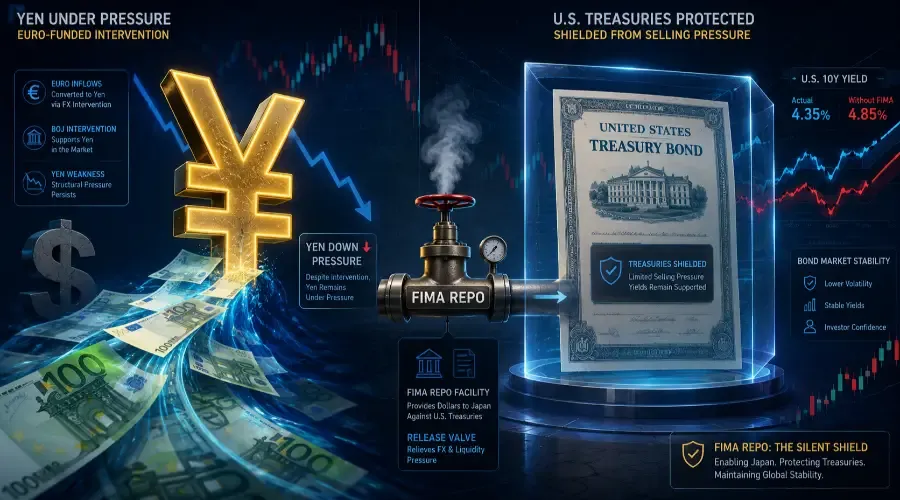
Late last week the headline was simple: the United States helped Japan prop up the yen, the first coordinated intervention between the two countries since 1998. Read as a currency event, it was notable but familiar. Yet the most revealing detail was not the intervention itself; it was how it was funded. Rather than selling dollars to buy yen–the standard playbook–the U.S. Treasury sold euros. That unusual choice, and the machinery assembled around it, points to something the foreign-exchange framing misses entirely.
Key takeaway: The operation may have been about more than defending the yen: it also appears designed to limit the risk of forced selling of U.S. Treasuries. Underneath a currency story sits a bond-market story, and the bond-market story is the more important one.
What Actually Happened
Over July 31 and August 1, the U.S. Treasury and Japan carried out a coordinated yen-buying intervention. Trades were executed by the Federal Reserve Bank of New York, with Goldman Sachs and Morgan Stanley selling euros to purchase yen on behalf of the U.S. government. A photographed note from Treasury Secretary Scott Bessent’s Camp David notepad revealed the intended scale: roughly $5 to $10 billion of yen purchases. The yen had touched a four-decade low near 164 to the dollar before the action, and strengthened by more than 1% on the day of the coordinated move, trading back around 157. Both governments then made a point of saying they would not hesitate to intervene again. On the surface, a textbook currency defense. The interesting part is the plumbing beneath it.
The Detail That Gives It Away: Euros, Not Dollars
Normally, buying yen to strengthen it means selling dollars. This time the U.S. sold euros from its reserves instead, and Bessent went out of his way to assure European officials that the euro sale was merely a reallocation of reserves. Why go to the trouble? Because selling dollars to defend the yen can require mobilizing or selling dollar-denominated assets, and the largest, most liquid pool of those assets is U.S. Treasuries.
Doing that at a moment when long-term Treasury yields are already elevated would risk adding supply and pressure to a market that does not need more of either. Using euros sidesteps that channel completely. The funding currency, in other words, was chosen specifically to accomplish the yen defense without touching the Treasury market.
To be fair, a former senior Treasury official called the euro tactic “weird,” and it is: selling a third currency is a less direct way to influence dollar-yen than selling dollars. The evidence for a bond-market motivation remains circumstantial; we cannot read minds in Washington. But the conjunction of the euro sale, the context of fragile long-end yields, and the officials’ simultaneous emphasis on backup liquidity tools makes the bond-protection thesis at least as plausible as a simple reserve rebalancing.
The Real Risk Was Never the Yen
Here is the part the currency framing obscures. The larger danger in the background was not a weak yen; it was what Japan might have to sell to defend one. Japan is the single largest foreign holder of U.S. Treasuries, and a scenario in which Tokyo dumps large quantities of them to finance a solo yen intervention is precisely what Washington wants to avoid.
The actual $5–10 billion operation was modest in size–barely a rounding error in daily Treasury trading–but the fear was the tail risk: an uncoordinated, protracted Japanese intervention that forced real, potentially disruptive Treasury sales. Oxford Economics described avoiding that outcome as “possibly one of the key reasons” behind U.S. participation, calling it a matter of self-preservation. Mizuho analysts made the same point, noting that U.S. involvement eased concern that Japan’s intervention might push Treasury yields higher.
The clearest tell was the tool both governments chose to highlight. Alongside the intervention, they emphasized Japan’s ability to use the Federal Reserve’s FIMA repo facility. Standing since 2020, FIMA repo lets a foreign central bank raise dollar liquidity by temporarily swapping its Treasury holdings for cash rather than selling them outright. It is a pressure-release valve built precisely for moments like this.
By publicly underscoring its availability, officials signaled that the plumbing was in place to prevent a fire sale of U.S. government debt. The euro funding, the U.S. participation, and the emphasis on FIMA repo are three expressions of a single objective, and that objective was the health of the U.S. bond market.
Why This Reframes the Episode
Once you see the intervention this way, it stops being a pure foreign-exchange story and becomes a rates story. It is a quiet acknowledgment that the U.S. Treasury market is sensitive enough that policymakers are now designing currency operations around not disturbing it. This linkage is not entirely new–central banks have long been mindful of reserve composition effects–but the explicit use of euros to circumvent the Treasury market marks a notable evolution.
And it exposes a feedback loop that does not disappear just because this round was handled carefully. If the yen stays weak and Japan is forced to keep intervening, the underlying pressure to eventually mobilize reserves, potentially including Treasuries, is deferred rather than removed. Markets that begin to price even the possibility of foreign-official Treasury selling can see rates volatility rise well before any actual selling takes place.
That is why the composition of Treasury demand matters as much as the headline amount of issuance. Treasury auction buyer mix can reveal whether domestic investors, foreign official institutions, banks, or other market participants are absorbing additional supply and whether the marginal buyer is becoming less dependable as yields rise.The intervention bought time on the currency. It also, inadvertently, spotlighted a vulnerability in the bond market that the funding gymnastics were meant to avoid poking.
The Other Side of the Read
It is worth being fair to the skeptics. Analysts at ING made the point about limits: intervention can buy time and create an inflection point, but it cannot overturn fundamentals like the U.S.-Japan interest-rate differential, and a coordinated action risks being remembered as slowing the dollar’s rise rather than reversing it.
In that reading, the euro-funding choice looks less like a masterstroke and more like an awkward compromise–less effective at moving dollar-yen but politically and financially more palatable. Japan, for its part, had its own reasons to cooperate: it preserved its dollar war chest and avoided the domestic political fallout of a solo, potentially ineffective, intervention. The honest view holds all of this at once: the funding choice genuinely reduced pressure on the Treasury market, yet it may still prove less effective at its stated currency goal. Those things are not contradictory.
What to Watch Next
A few signposts will show which way this develops. The first is simply whether the yen holds, or whether the authorities are forced to return, because repeated intervention steadily raises the pressure to mobilize reserves this operation was designed to avoid. The second is any signal about foreign-official Treasury activity, including usage of the FIMA repo facility, which is now the pressure-release valve of choice. The third is stress in Japanese government bonds, the upstream driver of the entire episode; if Tokyo’s own bond market destabilizes, the linkage to the U.S. Treasury market tightens rather than loosens. The currency screen is where people will keep looking. The bond market is where the more important story will actually be told.
The Bigger Picture
Step back and this connects to the same backdrop running through the rest of the market: elevated long-end yields and persistent questions about who absorbs a heavy supply of government debt.
The pressure is not isolated to foreign-exchange intervention. The broader AI investment cycle is also creating questions about how much additional corporate and sovereign debt the market must absorb. When the bond market starts repricing the financing burden of the AI boom, changes in Treasury yields can transmit directly into equity valuations, credit spreads and capital-allocation decisions.
The yen intervention added a new wrinkle, showing that the fragility of the Treasury market is now shaping how allied governments conduct currency policy.
It is a reminder that in a world of stretched sovereign balance sheets, foreign exchange and interest rates are one interconnected system, and that a currency operation in Tokyo can be, underneath, a maneuver to protect the bond market in Washington. The lesson for reading this cycle is to stop treating FX and rates as separate desks. Increasingly, they are the same story told in two currencies.
Related Reading
• Financials Sector Analysis: A Hawkish Fed Hold and a 19-Year-High Long Bond
• The Oil–Yield–Equity Loop: How an Energy Shock Moves the Whole Market
Disclaimer: BreakoutBulletin publishes educational and analytical content only. Nothing here is investment, financial, legal, or tax advice, or a recommendation or solicitation to buy, sell, or hold any security or currency. Details of the intervention and related commentary reflect public reporting available as of the publication date and may be revised. Past performance does not indicate future results. Readers should conduct their own research and consult a qualified, registered financial adviser before making any decision.
Potential Accuracy Notes
- The statement that the U.S. Treasury "sold euros" as the funding mechanism for the coordinated intervention and the associated inference that this was done to avoid Treasury sales may be subject to factual dispute and relies on interpretation rather than officially confirmed motivation.
- The assertion that the operation was "the first coordinated intervention between the two countries since 1998" should be independently verified against official historical records.
- The quoted intervention scale, exchange-rate levels, and attribution to Treasury Secretary Scott Bessent’s photographed notepad should be verified against primary or authoritative public sources.
- The characterization that the euro funding, U.S. participation, and emphasis on the FIMA repo facility were "three expressions of a single objective" is presented as an analytical interpretation rather than an officially confirmed policy objective.