
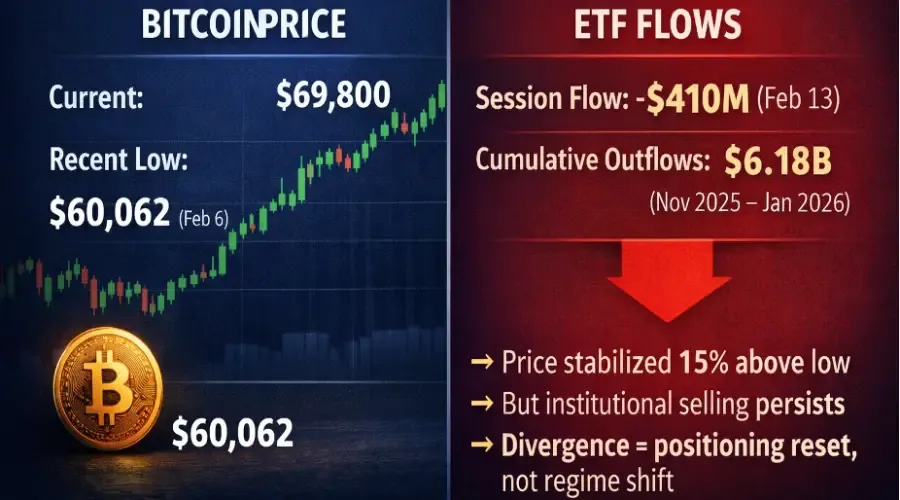
Bitcoin is holding near $69,800 after rebounding roughly 15% from its February 6 low of $60,062, a level that coincided with the lowest Fear & Greed Index reading on record at 5 Yahoo Finance.
The stabilization follows the February 13 CPI release, which eased Treasury yields and supported a modest recovery across Wall Street Investing.com. However, the structural tension defining this session is clear: price has recovered, but institutional ETF flows remain negative.
On the most recent U.S. session, spot Bitcoin ETFs shed $410 million even as BTC held its gains Coinbase. That divergence prevents classification as a regime shift and instead supports a positioning reset within a broader drawdown.
Primary Liquidity Driver
The dominant liquidity variable remains ETF outflows from the U.S. spot BTC complex.
From November 2025 through January 2026, the complex recorded approximately $6.18 billion in cumulative net redemptions Investing.com. The mechanical transmission chain has been direct:
ETF net outflows
→ Sponsor spot BTC selling
→ BTC decline (-52% from October 2025 ATH to February 6 low)
→ $1.26 billion in derivatives liquidations on Feb 5–6 Yahoo Finance
→ Leverage flush
→ Temporary stabilization
A structural nuance has emerged. On select heavy-outflow sessions, IBIT posted net inflows — for example, $60.03 million inbound while the broader complex shed $272 million Investing.com. This bifurcation suggests selective positioning by higher-conviction allocators rather than uniform institutional exit.
Reinforcing Signals
On-chain metrics show institutional demand has reversed materially. U.S. ETFs, which accumulated 46,000 BTC during comparable periods last year, are net sellers in 2026 CNBC.
Exchange net flows turned modestly negative post–February 6, consistent with reduced exchange-based selling, but not confirming renewed accumulation.
Stablecoin data shows only marginal USDT supply growth and flat USDC issuance. The absence of large-scale minting limits recovery velocity.
BTC dominance sits at 58.44%, essentially unchanged CoinMarketCap. Ethereum’s underperformance — falling from roughly $3,000 at the start of the year to around $1,955 — indicates no broad alt rotation. Capital is not dispersing across the asset class.
Derivatives and Positioning Context
The Feb 5–6 cascade cleared more than $1.26 billion in leveraged positions Yahoo Finance.
Since then:
Funding rates have shifted toward modestly positive territory.
Open interest has not materially expanded.
Options markets show continued demand for short-dated downside protection CoinDesk.
RSI on the daily timeframe sits near 31, approaching oversold territory BitcoinEthereumNews.com. Historically, this coincides with slowing momentum-driven selling but does not independently confirm trend reversal.
The absence of new leverage expansion is structurally cleaner than a leverage-fueled bounce, but it does not represent new institutional accumulation.
Cross-Asset Context
The 10-year Treasury yield stands near 4.12% and the 2-year at 3.47% Benzinga, reflecting residual rate repricing from the January jobs surprise.
The February CPI release moderated yields and supported equities Investing.com.
The DXY trades near 97.0, below its 50-day moving average — a configuration that typically provides mild support for risk assets. However, capital flows show rotation toward international equities, with the MSCI Asia Pacific index up 12% in 2026 Coinbase.
That rotation competes directly with crypto for risk capital.
Structural Implications
Three structural observations define this session.
First, ETF outflows remain the dominant structural headwind. The week of February 11 posted $311 million in inflows, nearly offsetting the prior week’s $318 million outflow Theweal, but the broader 2026 record shows only two positive weeks. The February 13 $410 million outflow reinforces that this is not yet a reversal trend.
Second, the leverage flush has reduced forced selling pressure. The absence of renewed liquidation cascades is neutral-to-constructive but incomplete without ETF confirmation.
Third, BTC dominance stability confirms concentration rather than expansion. Breadth has not improved.
Portfolio Context
Growth-oriented crypto allocations face no new confirmed directional signal. The rebound from $60,062 to approximately $69,800 reflects stabilization from extreme sentiment readings, but ETF flow data does not confirm institutional re-engagement.
Stablecoin-heavy defensive allocations show no systemic stress. The flat supply profile suggests dry powder, not active deployment.
Balanced frameworks must interpret IBIT’s selective inflow against broader complex outflows. Current data supports neither aggressive re-risking nor structural capitulation.
Bigger Picture
The macro regime entering the week of February 16 reflects partial inflation relief, repriced Fed expectations toward June 2026, and a crypto market that has absorbed a 52% drawdown from its October 2025 peak.
The Fear & Greed Index remains at 9 — Extreme Fear — after hitting 5 on February 6 Yahoo Finance. Historically, such sentiment readings precede reduced incremental selling pressure, but they do not independently produce recovery.
This session remains a positioning reset. ETF outflows represent persistent institutional de-risking. Post-liquidation stabilization represents mechanical exhaustion of forced selling. Neither framework is yet confirmed across liquidity, derivatives, on-chain, and cross-asset variables simultaneously.
This article is for informational and educational purposes only and does not constitute financial, investment, or trading advice. You are solely responsible for your own investment decisions and should consult a licensed financial professional before acting on any information in this post.