
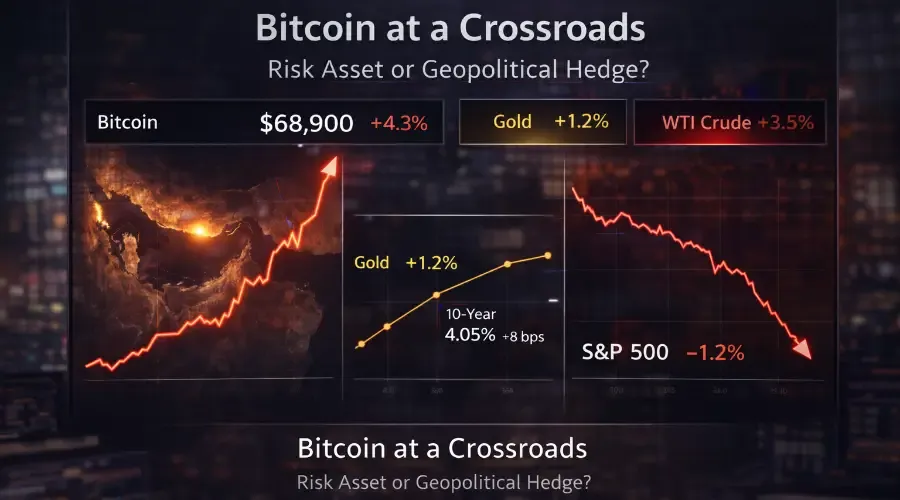
Two Frameworks for Understanding Today's Move - And Why Both Might Be Right
March 3, 2026 | BreakoutBulletin Crypto Commentary
Session Snapshot (as of 11:00 AM ET)
Bitcoin +4.3% - $68,900
Gold +1.2% - $2,045
WTI Crude +3.5% - $72.50
S&P 500 -1.2% - 5,412
Nasdaq 100 -1.6% - 21,450
2-Year Yield +13bps - 3.62%
10-Year Yield +8bps - 4.05%
VIX +2.1pts - 24.50
On most risk-off days, Bitcoin sells off alongside equities. The reasoning is mechanical: crypto has historically traded as a high-beta risk asset, amplifying equity downside when institutional desks reduce exposure across speculative positions.
Today is not following that script.
Bitcoin is rebounding 4-5% toward the $69,000-70,000 zone while equities decline, gold adds 1.2%, oil surges 3.5%, and the dollar strengthens 0.8%. That specific combination - BTC up alongside gold and oil, while equities fall - is the analytical anomaly worth unpacking. It does not happen frequently, and when it does, it typically signals a shift in how a meaningful segment of institutional capital is categorising the asset.
The question this session raises: is Bitcoin beginning to trade more like a geopolitical hedge and less like a leveraged equity proxy?
Two Competing Frameworks
To understand today's move, it helps to hold two competing analytical frameworks simultaneously - because the market itself has not yet resolved which one is dominant.
Framework 1: Bitcoin as High-Beta Risk Asset
Under this framework, Bitcoin's positive correlation with the Nasdaq is structural. Institutional portfolios that hold BTC treat it as the most volatile line item on their risk asset allocation - the position that gets cut first when VIX rises and the position that rallies hardest when liquidity expands.
What this framework would predict today: BTC weakness. With S&P futures down 1.2%, Nasdaq futures down 1.6%, and VIX spiking to 24.50, risk assets should sell off across the board. Any bounce is temporary; as risk-off sentiment deepens, the selling pressure that has not yet arrived in crypto will arrive, and the rebound will fade toward session lows.
Data points that support this framework:
BTC's correlation with QQQ has been statistically significant over the past two years, particularly during Federal Reserve-driven volatility events.
A rising 2-year yield (+13bps today) historically pressures BTC valuations through the same mechanism it pressures long-duration tech stocks - the discount rate applied to speculative future cash flows rises.
Funding rates across perpetual swaps remain muted, suggesting the move is not yet overleveraged - but that could change quickly if momentum attracts retail FOMO.
Framework 2: Bitcoin as Geopolitical Hedge
Under this framework, Bitcoin's response today is more structurally similar to gold than to QQQ. When a geopolitical shock threatens traditional financial system connectivity, Bitcoin offers a property that gold does not: borderless, instant settlement outside the traditional correspondent banking system.
Why a Hormuz disruption matters for Bitcoin:
Oil payments traditionally flow through the dollar-based correspondent banking system - a network that can be disrupted by sanctions, frozen accounts, or payment rerouting during geopolitical escalation. For institutions managing exposure to scenarios where the dollar-based system becomes less accessible, Bitcoin offers an alternative settlement layer that operates outside that infrastructure. Gold, despite its safe-haven status, cannot replicate this digitally - it requires physical transport, vaulting, and traditional custody channels that are themselves subject to the same geopolitical constraints.
What this framework would predict today: BTC strength alongside gold and oil, regardless of equity market direction. Institutional players hedging geopolitical-tail scenarios specifically will allocate to BTC as a complement to gold, not as a substitute for Nasdaq exposure.
Data points that support this framework:
BTC is up 4-5% on the same session that gold is up 1.2% and oil is up 3.5%.
The alignment with commodity hedges rather than with equity weakness is the key observation.
Open interest in BTC options has shown accumulation at $70,000+ strikes over the past week, suggesting institutional positioning ahead of potential escalation.
Why Both Frameworks Might Be Operating Simultaneously
The geopolitical element alone would be a straightforward catalyst to interpret. What makes today analytically richer - and more instructive - is the simultaneous rates dynamic.
The 2-year Treasury yield is up 13 basis points. The 10-year is up 8 basis points. The short end rising faster than the long end is the bond market's interpretation that this is a near-term event-risk repricing, not a structural inflation shock. That curve behavior matters for Bitcoin in a specific way:
If yields were rising due to long-duration inflation concern, Bitcoin would face a valuation headwind through the same channel as growth equities - higher risk-free rate reduces present value of speculative future scenarios.
But yields are rising primarily from near-term event risk rather than structural inflation, as today's curve shape suggests. This creates a unique dynamic: the near-term event risk simultaneously generates the geopolitical hedge demand that offsets the rate headwind.
The two forces are pulling in opposite directions. Today's price behavior suggests the geopolitical component is, at this moment, winning that tug-of-war. That is not a prediction - it is an observation of how the market is weighting each input in real time.
Neither framework is conclusively dominant based on a single session's price behavior. The analytical value is in holding both simultaneously and watching for the follow-through signal over the next 48-72 hours.
The $69,000-70,000 Zone: What Resistance Levels Reveal About Positioning
Bitcoin's rebound is testing the $69,000-70,000 area - a zone that has served as both support and resistance in recent months. The analytical significance of this level is not technical in isolation; it is behavioral.
Price levels that have been tested multiple times from both sides accumulate a concentration of pending orders - both from participants who bought at those levels and are watching for retest confirmation, and from participants who are positioned short and monitoring for a breakdown.
What to watch:
A clean acceptance above $70,000 with volume would suggest the geopolitical-hedge demand is absorbing the overhead supply that has historically capped rallies in this zone.
A rejection at $69,500-70,000 and a return toward $66,000-67,000 would suggest the risk-asset framework is reasserting itself as equity selling pressure deepens through the session.
Technical levels referenced from prior session highs and support zones. Independent validation across multiple timeframes is required before treating this zone as structurally confirmed.
Crypto-Native Data: What the On-Chain and Derivatives Tell Us
Traditional macro indicators tell part of the story. Crypto-native data adds another layer.
Funding Rates: Across major perpetual swap markets, funding rates remain in the 0.01-0.03% range - elevated but not extreme. This suggests the move is not yet overleveraged, which is notable because overleveraged moves tend to reverse violently. The absence of retail FOMO-driven leverage is a potential signal that institutional hedging, not speculative mania, is driving the rebound.
Open Interest: Total BTC open interest has increased approximately 8% over the past 24 hours, with the largest accumulation at $70,000 and $75,000 strike calls. This configuration - call buying without proportional perpetual leverage - is consistent with institutional hedging strategies rather than directional speculation.
Exchange Flows: Spot exchange reserves show a modest outflow over the same period, though not at the magnitude typically associated with accumulation events. The absence of aggressive selling into the rally suggests current holders are not treating this as a distribution opportunity - at least not yet.
What Would Confirm or Challenge the Geopolitical Hedge Thesis
What to Watch in the Next 48-72 Hours
Confirmation signals:
BTC holds above $68,000 even if equities continue to weaken through the week.
BTC correlation with gold strengthens relative to its correlation with QQQ over the next 5-10 sessions.
Institutional options activity suggests hedging rather than speculative positioning.
Funding rates remain subdued despite the price move.
Challenge signals:
BTC reverses sharply intraday as VIX continues expanding.
Geopolitical language moderates and BTC gives back the gain faster than gold does.
Crypto-specific negative news intersects with the macro weakness.
Funding rates spike above 0.1% as retail FOMO enters.
Why This Framework Matters Beyond Today
The specific catalyst - Iran strikes - will fade. But the analytical framework developed here is reusable for every future macro event.
Holding two competing models simultaneously rather than forcing a single narrative.
Watching the yield curve to distinguish near-term event risk from structural inflation.
Identifying the transmission mechanism behind asset behavior.
Using price levels behaviorally - as zones where real human decisions cluster, not as magic lines.
Incorporating asset-native data alongside traditional macro indicators.
Defining confirmation and challenge signals in advance so reactions are structured rather than emotional.
The geopolitics-plus-rates cocktail is not a scenario that most crypto analytical frameworks were built to handle simultaneously. Today is a live test of whether BTC's market structure has matured enough to navigate both inputs with differentiated behavior - or whether the high-beta risk-asset gravity eventually reasserts itself.
The Broader Takeaway
Today's session does not conclusively prove that Bitcoin has become a geopolitical hedge. What it does is raise the question - and position it for testing over the coming days and weeks.
Bitcoin spent much of 2022 trading as a leveraged equity proxy. It spent parts of 2020 and 2021 trading as a monetary debasement hedge. The question today's session is beginning to pose - can it trade as a geopolitical hedge? - may not resolve cleanly for weeks or months. But the positioning of that question, using live market data as the case study, is precisely how professional macro analysts build the interpretive frameworks they apply to future events.
Focus on the follow-through. That is where the regime signal lives.
DISCLAIMER:
This article is for informational and educational purposes only and does not constitute financial, investment, or trading advice. You are solely responsible for your own investment decisions and should consult a licensed financial professional before acting on any information in this post.