
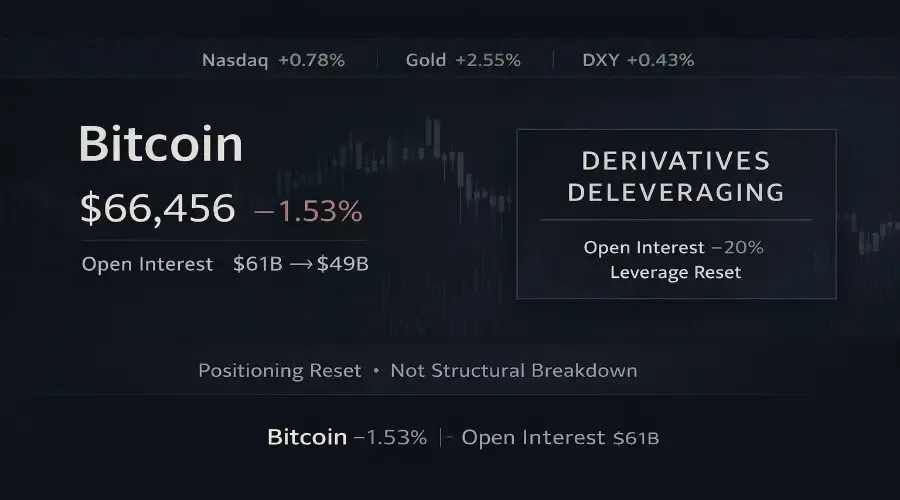
The dominant structural development in crypto markets over the 24-hour period ending midnight UTC on February 19, 2026 was not a macro catalyst. It was a derivatives positioning reset.
Bitcoin declined 1.53% to $66,456.35. Ethereum fell an estimated 2.0% to approximately $1,954.75. The move unfolded against a broadly constructive macro backdrop: U.S. equities advanced, gold gained 2.55%, and FOMC minutes reinforced soft-landing confidence in traditional markets.
The divergence is the session’s central read. Crypto weakness alongside equity strength suggests internal positioning dynamics are currently exerting more influence than cross-asset transmission.
For broader structural framing, see the Crypto Market Structure Guide.
Primary Liquidity Driver
The primary mechanism was derivatives deleveraging rather than spot liquidation or ETF redemption pressure.
Bitcoin Open Interest declined from a recent peak of $61 billion to approximately $49 billion — a contraction exceeding 20%. That reduction in notional exposure represents systematic leverage unwinding rather than fundamental reassessment.
The transmission sequence is consistent with prior cycles:
Elevated OI during price advance → Funding costs rise → Leveraged longs become expensive → Exposure reduced → OI contracts → Price adjusts to reflect lower leveraged demand.
This $12 billion contraction reflects clearing of positioning excess. Structurally, deleveraging episodes that occur without confirmed exchange inflow spikes or ETF acceleration tend to resolve as range normalization rather than directional regime shifts.
The $60,000 level remains a reference zone identified in research as a potential liquidation trigger area. That threshold was not tested in this session.
For deeper structural context, see the Derivatives Positioning Guide.
Reinforcing Signals
On-chain data offers partial confirmation of the deleveraging thesis.
Stablecoin supply expanded to $266 billion, with approximately $166 billion on Ethereum. Elevated stablecoin balances are often interpreted as internal liquidity retained within the ecosystem rather than exiting to fiat. However, supply figures alone do not confirm redeployment intent.
The On-Chain Analytics Framework outlines how stablecoin metrics require exchange flow confirmation for stronger directional interpretation.
A movement of 2,043 dormant BTC — inactive for seven years — occurred on February 11. Such transfers are observationally notable but analytically ambiguous. Without additional context, they do not confirm distribution or accumulation intent.
Exchange net flow data for the specific session was unavailable. As a result, confirmation remains incomplete.
Bitcoin dominance near 60% suggests capital concentration within the asset class rather than broad altcoin rotation — a posture historically associated with defensive bias.
Derivatives & ETF Context
The >20% Open Interest contraction is the most concrete structural data point.
Such a reduction can reflect either forced liquidation or voluntary risk reduction as funding conditions normalize. Funding rate specifics were unavailable; directional inference suggests neutral to slightly negative positioning consistent with long bias unwinding.
ETF flows introduce a longer-horizon anchor. Year-to-date Bitcoin ETF inflows stand at $14.2 billion. That multi-month accumulation baseline remains intact despite recent daily volatility.
IBIT flows remained positive in recent tracker data, reinforcing the institutional allocation backdrop.
The ETF Flow Analysis Guide provides a framework for distinguishing short-term flow variability from structural capital allocation trends.
Cross-Asset Context
Cross-asset behavior did not align with crypto’s move.
Nasdaq gained 0.78%. Gold rose 2.55% to $5,003.51. The DXY strengthened 0.43% to 97.577. In a traditional risk-on configuration, crypto might be expected to participate. It did not.
This non-alignment reinforces the interpretation that internal derivatives positioning — not macro transmission — drove the session.
The gold advance, occurring alongside equity strength and a firmer dollar, represents an atypical cross-asset configuration. Whether that dynamic influences Bitcoin’s store-of-value narrative is not resolved by current data.
The 10-Year yield’s modest 2-basis-point increase to 4.09% was not material enough to independently explain crypto price behavior.
Structural Implications
This session does not meet criteria for structural regime change.
BTC’s decline was under 3%. Liquidity contracted rather than expanded. On-chain confirmation was partial. Cross-asset alignment was absent.
The appropriate classification is a positioning reset — an orderly unwinding of leverage accumulated during prior price expansion.
Year-to-date ETF inflows provide a structural institutional anchor distinguishing this cycle from earlier deleveraging phases that lacked comparable allocation support.
BTC dominance near 60% reflects internal concentration rather than speculative expansion.
Portfolio Context
Growth-Heavy Crypto Portfolios:
The OI contraction reduces embedded leverage across the market. From a structural standpoint, lower systemic leverage can represent a healthier baseline than elevated funding-rich conditions. Portfolio review centers on leverage calibration relative to market-wide deleveraging.
Stablecoin-Heavy Positioning:
The $266 billion stablecoin supply suggests significant capital remains within the crypto ecosystem. Whether that capital redeploys depends on signals not yet confirmed in this session’s data.
Balanced Crypto Portfolios:
The divergence between crypto weakness and macro strength does not independently justify reallocation. It warrants observation — specifically, whether OI stabilizes at lower levels or continues contracting.
Bigger Picture
The broader macro regime remains intact. Traditional markets interpreted FOMC minutes as confirmation of a soft-landing narrative. Crypto did not mirror that strength, but neither did it exhibit disorderly liquidation.
The tension to monitor lies between two variables:
• The $14.2 billion structural ETF inflow baseline
• The tactical derivatives positioning reset reflected in OI contraction
When those variables realign — through stabilized Open Interest and consistent ETF flow direction — the structural picture becomes clearer.
Until then, this episode reflects internal positioning normalization rather than macro-driven repricing.
Disclaimer:
This is a capital-flow analysis column produced by BreakoutBulletin for educational and informational purposes only. It does not constitute financial advice, investment recommendations, or trading guidance of any kind. All content reflects interpretation of publicly available market data. Readers should conduct independent research and consult a licensed financial professional before making any investment decisions.