
Bitcoin Drifts Lower as ETF Inflows Hold and Layer-1s Outperform
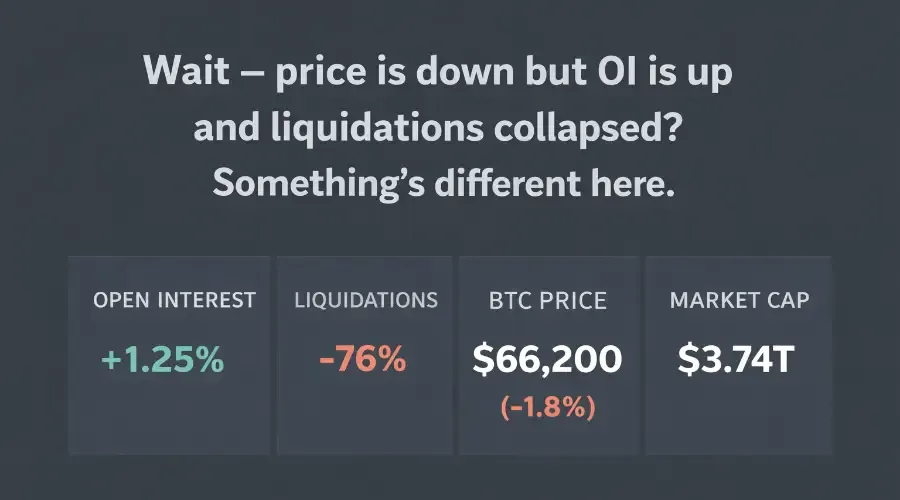
The dominant feature of the 24 hours into 06:45 UTC on February 13 is not Bitcoin’s modest decline - it is the divergence between price direction and underlying liquidity data. BTC fell 1.8% to $66,200, compressing total crypto market capitalization by approximately 1.9% to $3.74 trillion. On the surface, that reads as a risk-off session. Below the surface, the evidence does not support that interpretation.
Exchange net flows show Bitcoin leaving venues, not entering them. Stablecoin supply moved marginally higher, not lower. Spot BTC ETF flows recorded net inflows during the most recent U.S. session. Derivatives open interest expanded slightly. Liquidations collapsed 76% versus the prior period. None of these are the fingerprints of a driven sell event.
What this session more closely resembles is a positioning adjustment - a modest price reset in an asset where leverage had accumulated, while capital rotated into Layer-1 alternatives. The session’s relative strength was concentrated in SOL, ADA, and AVAX, each outperforming BTC over the 24-hour window.
PRIMARY LIQUIDITY DRIVER
The structural anchor remains positive flow into spot BTC ETF products. ARKB and BITB both recorded gains of approximately 4.5% in the prior U.S. cash session, with aggregate net inflows across major U.S. spot BTC ETFs landing in the low hundreds of millions of dollars - all major issuers positive.
ETF flows represent persistent, non-leveraged demand. Unlike futures-driven positioning, ETF inflows reflect institutional allocation decisions that do not unwind with a single funding rate shift. Cumulative flows for both ARKB and BITB continue to trend higher from initial listing levels - a structural demand signal that contrasts with 24-hour price softness.
Transmission chain:
ETF net inflows (U.S. session) → Structural BTC demand absorbed → No exchange inflow spike on-chain → BTC price drift attributed to organic selling, not institutional exit → Demand floor intact, softness not liquidity-driven
REINFORCING SIGNALS
On-chain flows show BTC exchange net outflows over the past 24 hours - more BTC leaving exchanges than entering. This directly contradicts a narrative of heavy on-venue selling pressure. ETH flows were near zero, showing no directional institutional move.
Stablecoin activity remained stable. USDT supply drifted marginally higher (+0.1–0.2%), USDC was flat. No large minting or burning event occurred. All major stablecoins held within 0.1% of peg - no stress signal.
BTC dominance compressed to approximately 35% as ETH gained 1.8% and the Layer-1 complex outperformed. The move remains within normal 24-hour variance and does not meet the threshold for a confirmed dominance regime shift.
Sector rotation was real but concentrated. The Layer-1 basket (SOL +5.1%, ADA +4.0%, AVAX +3.9%) exceeded the 5% sector threshold. DeFi, AI infrastructure, gaming, and RWA sectors remained within +1–4%. This is tactical reallocation into established L1s rather than broad altcoin expansion.
DERIVATIVES & POSITIONING CONTEXT
The derivatives structure reflects a low-conviction session. BTC futures open interest expanded modestly (+1.25%) while 24-hour futures volume collapsed 38.3%. Rising OI with falling volume indicates positions are being held rather than aggressively built. This is not an accumulation signature - it is a holding pattern.
ETH futures open interest contracted approximately 49% over the same window - a notable reduction in leveraged ETH exposure. Given ETH’s positive price move (+1.8%), this suggests the move was driven by spot demand rather than leverage, a structurally cleaner signal.
Funding rates on BTC remain mildly positive across major venues (approximately +0.01% per 8 hours), with ETH near +0.003%. These readings signal a modest long bias but not the elevated conditions that precede forced liquidation events. Total liquidations of $90.8 million, down 75.8% from the prior period, confirm that no significant forced unwind occurred.
Options skew shows a mild call-side preference in near-dated BTC risk reversals, little changed day-on-day. Implied volatility in the mid-40s annualized range sits close to recent averages. The options market is not pricing an elevated risk event.
CROSS-ASSET CONTEXT
Macro cross-asset movement remained below material thresholds. DXY traded just under 97, down approximately 0.1%. The U.S. 10-year yield held in the 4.1–4.2% range. Nasdaq futures oscillated within ±0.3%. Gold and oil remained within ±0.75%.
The absence of macro alignment is itself informative. Following Wednesday’s jobs-driven repricing of Fed cut expectations to June at 93.6% probability, crypto’s muted response suggests the rate adjustment was largely absorbed. No new macro catalyst arrived overnight to extend or reverse that shift.
STRUCTURAL IMPLICATIONS
This session’s liquidity regime is best described as stable with mild rotation pressure. The three-factor alignment required to declare a regime shift - material BTC move, on-chain confirmation, and cross-asset alignment - was not present.
Instead, the market reflects a functioning two-speed structure. BTC remains the liquidity anchor - absorbing ETF inflows, maintaining exchange outflow discipline, and holding above support - while higher risk capital rotates into the Layer-1 complex.
Breadth remains narrow. Until DeFi, infrastructure, and smaller-cap sectors begin advancing alongside L1s, this rotation should be interpreted as continuation rather than transition.
PORTFOLIO CONTEXT
For growth-heavy crypto allocations, the session provides limited new signal. BTC’s modest decline alongside continued ETF inflows creates ambiguity rather than confirmation. The Layer-1 outperformance may warrant review of relative exposure, but does not represent a structural trigger.
For stablecoin-heavy defensive positioning, no peg instability, exchange-flow spike, or liquidity stress emerged. The defensive rationale is neither strengthened nor invalidated.
Balanced allocations appear aligned with the current environment. Divergence between price softness and positive structural flows represents precisely the type of complexity diversified positioning is designed to absorb.
BIGGER PICTURE
The macro regime entering February 13 remains defined by a single dominant tension: labor market strength has repriced Fed policy expectations, and markets await CPI data at 8:30 AM ET to determine whether inflation confirms or diverges from that signal.
Crypto behaved as a partially decoupled asset class during this session. ETF inflows continued despite hawkish repricing, and on-chain data showed no exchange-driven selling. Whether this reflects durable institutional conviction or temporary correlation lag will become clearer as CPI and equity reactions provide firmer macro anchoring.
CONTINUE YOUR EDUCATION
Understanding sessions where price direction diverges from liquidity data requires a multi-framework approach. Interpreting ETF flows, on-chain activity, derivatives positioning, and sector rotation simultaneously reduces the risk of single-variable misreads.
Foundations
• Bitcoin Basics Guide - What Bitcoin is, how it functions, and why it serves as a liquidity anchor
• Ethereum Explained - ETH’s infrastructure role and structural differences from BTC
• Crypto Market Structure - How exchanges, venues, and capital flows interact
Risk & Tools
• Position Size Calculator - Align exposure with risk tolerance
• Risk-Reward Calculator - Evaluate structural asymmetry before entry
• Crypto Risk Management Guide - Framework for leverage, correlation, and drawdown control
Advanced
• ETF Flow Analysis Guide - Interpreting daily inflow and outflow data
• On-Chain Analytics Framework - Exchange flows, dormancy, and stablecoin metrics
• Derivatives Positioning Guide - Open interest, funding rates, liquidations, and skew
⚠️ Educational commentary only. Not financial advice.