
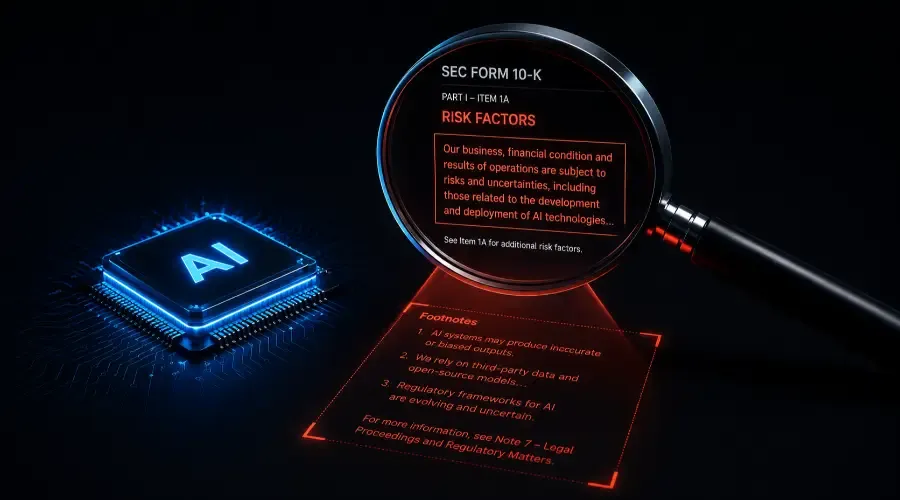
Inside Microsoft and Oracle’s latest 10-Ks, legal disclaimers reveal stranded capacity, asset impairment, and power-cost traps ($MSFT, $ORCL).
BY MANISH T. · BREAKOUTBULLETIN · AUGUST 5, 2026
Every quarter, the AI-infrastructure story gets louder: bigger capex numbers, bigger backlogs, more data centers. What gets almost no airtime is the place where the companies themselves, under legal liability, spell out how it could go wrong – the risk-factor section of the annual report. Read Microsoft’s ($MSFT) and Oracle’s ($ORCL) fiscal-2026 10-Ks side by side and you find the bear case written in their own words.
Microsoft ($MSFT) Put “Impairment” in Writing
Microsoft’s FY2025 10-K already warned that capacity constraints could cause “operational disruptions” and that AI investments might not yield expected returns. In the FY2026 filing, that language evolved. The company added that overestimating demand or misaligning capacity investment can cause underutilized infrastructure and “may lead to impairment of assets on our balance sheet.”
That specific admission – that the long-lived assets themselves could be written down – is new.
The same risk factor lists the AI cost structure (model training and inference costs, component availability and pricing, energy) as uncertain, and warns margins could suffer if those costs stay elevated or if AI pricing falls to competition and commoditization.
A separate factor describes demand potentially outpacing Microsoft’s ability to add capacity, with reliable, affordable power as the binding constraint, alongside zoning, environmental review, organized local opposition, and skilled-labor shortages.
None of that is a forecast. It is the company telling you which assumptions, if wrong, hit the balance sheet.
Oracle ($ORCL) Described a Margin Trap
Oracle’s FY2026 10-K goes further in one specific way. It warns that rising energy costs can compress margins “particularly where customer pricing is fixed or committed.”
Read that slowly: Oracle is describing the classic squeeze of selling capacity at a fixed price while the power bill underneath it moves – and it says it has already faced challenges securing reliable, cost-effective power because energy is globally constrained by AI-compute demand.
Its risk litany, in its own framing, includes stranded capacity, customer defaults, excess leases, and credit risk – the exact failure modes a skeptic would list, disclosed by the company building the capacity.
It’s fair to note that many cloud contracts are not purely fixed-price; they often include usage-based billing or energy pass-through mechanisms. Oracle’s warning therefore likely reflects a subset of its commitments where those protections are absent. Still, the company feeling compelled to flag this specific mismatch – and the fact that it’s already experiencing procurement friction – is a signal worth tracking.
A Reality Check on Item 1A Language
Risk factors are, by design, exhaustive and pessimistic. Companies list every conceivable disaster, no matter how remote, and the addition of impairment language could simply reflect a larger balance sheet rather than a higher internal probability of loss.
However, when two of the largest builders independently add the same narrow concept – asset impairment from misaligned capacity, and a margin squeeze from power costs colliding with fixed pricing – it suggests a shared concern that wasn’t considered material enough to detail a year earlier. That shift, even if only in legal caution, serves as a quality filter for how you read the backlog.
Why This Is an Institutional Edge, Not a Bear Thesis
The point is not to short the buildout. It is that risk-factor changes – the year-over-year edits to Item 1A – are a documented, under-read source of information precisely because they are tedious to track.
When two of the largest builders independently add language about impairment, stranded capacity, and a power-cost-versus-fixed-price mismatch, that should sharpen the questions you ask about remaining performance obligations (RPO). The headline RPO number gets treated as gospel in the bull case; the filings themselves flag counterparty and duration risk inside that number.
SIGNAL VS NOISE
Noise: “Hyperscaler raises AI capex guidance again.” Widely covered, already the consensus narrative.
Signal: In Item 1A, Microsoft ($MSFT) added that misaligned capacity “may lead to impairment of assets,” a phrase absent from the prior year’s filing. Oracle ($ORCL) warned energy costs hurt margins “where customer pricing is fixed or committed,” listing stranded capacity and customer defaults among its risks. The builders’ own caveats – barely covered.
WATCH · TRACK · MEASURE
Watch: The year-over-year risk-factor diffs in each hyperscaler’s next 10-K – new impairment or stranded-capacity language is the tell. Look for words that shift from “could disrupt operations” to “may lead to impairment.”
Track: The quality of RPO – duration, counterparty concentration, and, where disclosed, the share of fixed-price commitments versus pass-through or consumption-based structures. That mix determines how much of the backlog is exposed to the squeeze Oracle describes.
Measure: Power-cost commentary against contracted customer pricing – the gap the Oracle language points to. When energy cost projections move, ask which side of that gap the company sits on.
BreakoutBulletin Thesis
The most honest bear case for a hot trade is often written by the company running it – in the one section of the filing nobody reads aloud on the earnings call.
Source Documents
Microsoft Corp. Form 10-K, Item 1A “Risk Factors” (fiscal year ended June 30, 2026); Oracle Corp. Form 10-K, Item 1A “Risk Factors” (fiscal year ended May 31, 2026). Filings accessed via SEC EDGAR.
BreakoutBulletin publishes educational market analysis for informational purposes only. This is not investment advice and not a recommendation to buy, sell, or hold any security. Markets carry risk; conduct your own research and consult a registered financial adviser before acting. Figures are drawn from public regulatory filings as of the date shown and are subject to change.
Potential Accuracy Notes
The article refers to Microsoft FY2026 and Oracle FY2026 Form 10-K filings as existing source documents. If those filings were not publicly available as of the stated publication date, this citation would be inaccurate. The formatting has not been modified.