
Before the Bureau of Labor Statistics released February's payroll data at 8:30 AM ET, financial markets had already positioned themselves into a specific configuration. Understanding that pre-release configuration is essential context for understanding why the -92,000 payroll print produced the magnitude of reaction it did.
Markets do not react to data in isolation. They react to the gap between what the data showed and what the market had positioned for. The wider that gap - and the more one-sided the pre-release positioning - the larger the post-release price adjustment required.
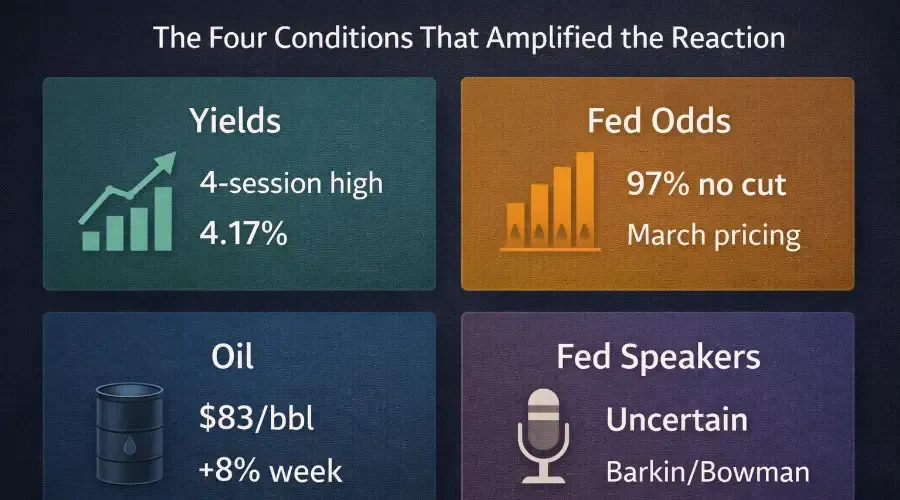
This morning's setup was notable for its asymmetry. Heading into 8:30 AM, the market was positioned for a resilient labor market, had absorbed four consecutive sessions of rising yields, was sitting with oil elevated on an active geopolitical supply shock, and had compressed Fed rate-cut odds to near-zero for the near term. Each of those conditions made the downside surprise in payrolls more impactful, not less.
Primary Setup: Four Conditions That Amplified the Reaction
Condition 1: Yields at a four-session high entering the release
The 10-year Treasury yield had risen for four consecutive sessions heading into the morning, reaching approximately 4.14%-4.17% in pre-market trading. S&P 500 E-mini futures were already reflecting this pressure - down roughly 0.53% pre-market while the 10-year yield was noted near 4.169% in one snapshot.
Four days of rising yields typically reflect a market pricing persistent inflation or economic resilience. A labor-market shock that forces yields to reverse therefore hits a market that had already leaned in the opposite direction. The sharper the pre-release yield move, the stronger the potential reversal when the data contradicts positioning.
Condition 2: Rate-cut odds compressed to near-zero
CME FedWatch showed roughly 97.3% odds of no March rate change entering the session. Markets had effectively converged on a "higher for longer" stance, with only one cut priced for all of 2026.
When probability is that compressed, even a modest repricing toward cuts can produce large moves in rate-sensitive assets. The starting point matters as much as the data itself.
Condition 3: Oil elevated by an active geopolitical shock
WTI crude had risen sharply on Iran-related supply disruption headlines. Prior session reports noted oil rising more than 3% intraday, while Brent had traded more than 8% higher on the week.
Elevated oil introduces a second inflation signal that complicates interpretation of weak labor data. Equity futures were lower while yields were rising - a configuration reflecting simultaneous inflation concern and growth uncertainty. That cross-asset environment often amplifies volatility around major data releases.
Condition 4: Pre-release uncertainty from Fed speakers
Federal Reserve officials including Barkin and Bowman had commented on the Middle East shock during the week. Their remarks emphasized uncertainty around the duration of the oil-driven inflation impulse.
That communication signaled the Fed itself recognized competing pressures, meaning any data surprise would not produce a simple policy interpretation.
Reinforcing Signals: The Pre-Market Tape
The pre-market futures tape reflected those four conditions.
SPY traded near 682.08, roughly 0.2% below its pre-market VWAP of 683.64.
QQQ traded around 607.45, about 0.3% below its VWAP of 609.21.
DIA traded near 481.85, roughly 0.1% below its VWAP of 482.36.
The divergence between Dow and Nasdaq futures was informative. The Dow carries heavier exposure to industrials and consumer-facing sectors, which are more sensitive to higher energy costs and growth uncertainty.
Nasdaq futures held relatively firmer as technology names often attract defensive flows during uncertain macro conditions.
All three ETFs trading below VWAP suggested a market lacking conviction before the data release. Participants were reducing exposure and waiting for direction.
Cross-Asset Pre-Release Configuration
Treasury yields traded near 4.14%-4.17%, marking a four-session high and positioning for economic resilience.
The U.S. dollar index near 99.03, down about 0.29%, reflected modest uncertainty around whether labor data would justify elevated yield levels.
The VIX traded between roughly 20.7 and 23.35, rising through the week and signaling increased demand for protection before the release.
Crude oil remained elevated following the earlier supply shock. This created a cross-asset tension where weak labor data could be interpreted as dovish, but higher energy prices maintained inflation pressure.
The Market Structure Lesson
The pre-release setup illustrates how positioning amplifies reactions to economic data.
When consensus is heavily aligned in one direction - rising yields, near-zero rate-cut odds, elevated volatility - the market effectively writes a script for the data.
If the data confirms expectations, the move is often limited. But if the data contradicts expectations, rapid repositioning becomes necessary.
The February payroll surprise forced that repositioning.
The VIX spike and cross-asset volatility were not solely reactions to the payroll number. They reflected the gap between expectation and outcome.
Understanding that asymmetry is as important as understanding the data itself.
Structural Implications of the Pre-Data Setup
The conditions before the release suggest the market was insufficiently hedged for a labor-market downside surprise.
The ADP payroll report earlier in the week exceeded expectations, reinforcing confidence that official BLS payroll data would show continued labor strength.
That confidence was visible in rising yields and compressed rate-cut probabilities.
When a leading indicator points one way and the official release moves the opposite direction, uncertainty increases. Market participants must reassess both the data and the signals they previously relied upon.
Fed speakers scheduled during the week - including Waller, Daly, Goolsbee, Barkin, and Bowman - now face the task of addressing the new labor-market signal.
Portfolio Context
The pre-release environment reveals the vulnerability of consensus positioning.
Portfolios constructed around a resilient labor market and persistent higher rates were exposed to several risks once the payroll data contradicted that view.
These portfolios typically held underweights in long-duration bonds, overweights in financial stocks, and reduced volatility hedges.
When the payroll shock arrived, those assumptions faced immediate pressure.
Portfolios maintaining defensive hedges - including Treasury exposure or rate-sensitive sectors - experienced the opposite effect.
Bigger Picture
The March 7, 2026 pre-market configuration offers a clear example of how positioning interacts with economic data.
Extreme consensus positioning, multi-session yield trends, rising volatility, and geopolitical shocks are not unusual in financial markets.
What matters is how those conditions shape the reaction to new information.
Professional participants analyze pre-release positioning not to predict the data itself, but to understand how markets might react if expectations prove incorrect.
A one-sided consensus creates a one-sided risk profile.
When the payroll number contradicted that consensus, the market had to adjust quickly.
The reaction was large not only because the data surprised, but because of the positioning into which that surprise arrived.
DISCLAIMER :
This article is for informational and educational purposes only and does not constitute financial, investment, or trading advice. You are solely responsible for your own investment decisions and should consult a licensed financial professional before acting on any information in this post.