
AutoZone reports Q2 FY2026 results before the open on March 3. The setup presents an instructive case in investor psychology.
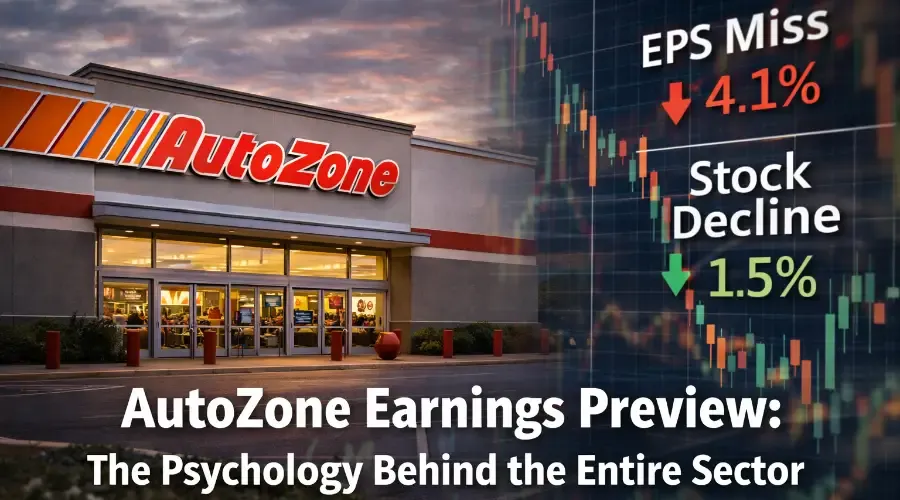
In Q1, AutoZone missed EPS by 4%. The stock declined only 1.5%.
A 4% earnings miss resulting in a 1.5% price decline challenges the assumption that negative surprises automatically trigger proportional selloffs. Understanding why the reaction was muted is critical to framing Q2 expectations.
TL;DR
-
Q1 EPS missed by 4%, but revenue held near consensus.
-
The stock fell only 1.5% due to positioning and perceived one-off cost pressure.
-
A second miss could shift interpretation from noise to pattern.
-
Buyback pace functions as a confidence signal.
-
Options imply approximately ±8%, modestly above the 7% historical average.
-
Commentary on forward trends will shape the reaction more than the headline EPS number.
Q1 Reaction: Revenue Versus EPS
In Q1, AutoZone reported EPS of $31.04 versus $32.33 consensus. Revenue was $4.63B versus $4.64B consensus.
The negligible revenue miss signaled that demand remained intact. Investors often differentiate between revenue-driven and cost-driven earnings misses.
A revenue shortfall challenges the business model. A margin-driven EPS miss, particularly one tied to supply chain costs or wage inflation, can be interpreted as temporary.
Because revenue held, investors treated the EPS shortfall as a cost issue rather than a demand deterioration.
Positioning and Pattern Recognition
Another factor behind the muted reaction was positioning. If institutional investors are not aggressively long heading into earnings, there are fewer forced sellers when results disappoint.
Additionally, AutoZone has a long history of consistent execution. A single quarterly miss can be interpreted as noise.
However, psychology shifts quickly.
One miss invites patience. Two consecutive misses introduce pattern recognition. A repeat EPS shortfall in Q2 would likely be interpreted more severely, as investors reassess margin durability rather than assuming a one-time event.
Buybacks: EPS Architecture or Confidence Signal
AutoZone is one of the most active share repurchasers in the S&P 500. Over time, share count reduction has supported EPS growth.
Investors interpret buyback activity as revealed preference.
Accelerated buybacks suggest management confidence in cash generation and intrinsic value. That provides both mechanical EPS support and psychological reassurance.
Decelerated buybacks, particularly without clear explanation, raise questions about free cash flow sustainability.
If management announces a new or expanded authorization, it signals multi-year confidence regardless of quarterly volatility.
Guidance Without Formal Guidance
AutoZone does not provide formal quarterly EPS guidance. This places greater emphasis on qualitative commentary.
Investors will monitor:
Specificity around commercial account growth.
Quantified discussion of supply chain costs.
Clarity on tariff mitigation strategy.
Any reference to February or early March sales trends.
Specific language signals internal visibility. Vague macro-referenced language increases uncertainty.
Without numeric guidance, tone and detail become primary valuation inputs.
Options Market Expectations
Options markets imply approximately a ±8% post-earnings move, modestly above the 7% historical average.
For a historically stable operator, even a 1 percentage point premium above historical implied volatility suggests elevated uncertainty following the prior EPS miss.
An implied move reflects magnitude, not direction.
Dollar Magnitude Versus Percentage Framing
AutoZone trades around $3,200 per share. Percentage framing can obscure capital exposure.
A 7% move on a $50 stock equals $3.50 per share. A 7% move on a $3,200 stock equals $224 per share.
The percentage is identical. The capital impact differs materially.
Institutional investors focus on capital-at-risk rather than nominal share price. Retail investors sometimes underestimate exposure when evaluating percentage-based moves in high-priced stocks.
What Will Drive Q2 Reaction
A constructive outcome would include an EPS beat that reverses the Q1 pattern, stable or improving revenue, sustained buyback activity, and specific commentary on cost management.
A negative outcome would include another EPS miss, particularly if accompanied by revenue softness, reduced buyback pace, or vague commentary around tariffs and forward trends.
The market will not treat these outcomes symmetrically.
The Bottom Line
AutoZone’s Q2 earnings represent a test of narrative stability.
If Q1 was a one-off margin event, Q2 can restore confidence. If Q2 reinforces margin pressure, investors may shift from assuming temporary disruption to questioning structural profitability.
In this context, psychology matters as much as arithmetic.
Frequently Asked Questions
When does AutoZone report earnings?
AutoZone reports Q2 FY2026 earnings before the open on March 3.
Why did a 4% EPS miss only lead to a 1.5% stock decline?
Revenue held near consensus, positioning was cautious, and investors viewed cost pressure as potentially temporary.
Why are buybacks important for AutoZone?
Share repurchases support EPS growth and signal management confidence in cash generation.
What does a ±8% implied move mean?
It reflects the magnitude of price movement options markets expect around earnings, not a directional forecast.
DISCLAIMER:
This article is for informational and educational purposes only and does not constitute financial, investment, or trading advice. You are solely responsible for your own investment decisions and should consult a licensed financial professional before acting on any information in this post.