
2. Why Most Retail Algos Fail Before They Start
The failure usually isn’t technical, it’s that the strategy got fit to the past.
You test an idea on five years of historical data, tweak parameters until the equity curve looks perfect, and what you’ve really done is memorize the random noise of that specific timeframe.
Run it forward on unseen data and the edge evaporates.
Beyond overfitting, retail traders face US-specific execution traps:
The Intraday Margin Shift:
For decades, the Pattern Day Trader (PDT) rule required a $25,000 minimum balance for traders making four or more day trades in five business days.
The $25,000 floor and PDT designation are being eliminated in favor of a real-time intraday margin standard.
Removing that barrier doesn't remove the risk—thinly capitalized accounts still burn through drawdowns quickly.
Friction & Costs:
Commissions, market spread, and slippage (the gap between your backtest fill price and actual execution) quietly destroy paper edges.
A strategy showing a 0.2% expected gain per trade will easily bleed out when a single penny of slippage eats half that margin.
Deep Dive: Read our analysis on The PDT Rule Change & Why Retail Algos Really Lose Money ➔ https://www.breakoutbulletin.com/article/why-retail-algos-fail-pdt-rule
3. From an Idea to Rules a Computer Can Follow
Translating a strategy means converting subjective English into unambiguous logic.
Subjective:
"Buy the breakout on strong volume and risk a small amount."
Objective:
"Enter long on the next bar open when the daily close exceeds the 20-day high and volume is at least 1.5 times the 20-day moving average. Size position to risk exactly 1% of account equity against a stop-loss set at the 10-day low."
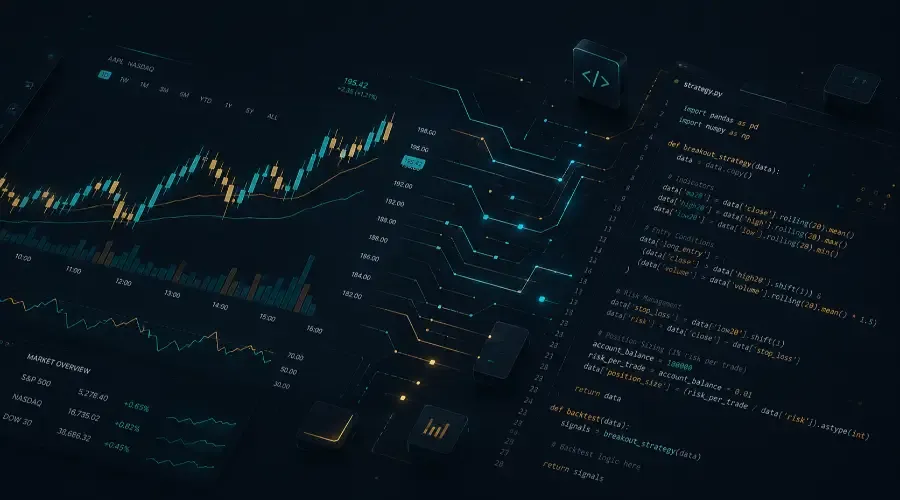
Here is how that exact breakout rule translates into executable Python logic:
import pandas as pd

# 1. Define explicit indicator rules
df['high_20'] = df['high'].rolling(20).max().shift(1)
df['vol_20_avg'] = df['volume'].rolling(20).mean().shift(1)
df['low_10'] = df['low'].rolling(10).min().shift(1)

# 2. Entry Condition (No ambiguity)
entry_signal = (df['close'] > df['high_20']) & (df['volume'] > 1.5 * df['vol_20_avg'])

# 3. Position Sizing Logic (Fixed 1% risk rule)
account_balance = 25000.00
risk_per_trade = account_balance * 0.01

entry_price = df['close']
stop_loss_price = df['low_10']
risk_per_share = entry_price - stop_loss_price

# Calculate position size in shares
df['position_size'] = (risk_per_trade / risk_per_share).astype(int)
Honest Backtesting Discipline
Writing the code is only step one; testing it without fooling yourself is where the real work begins.
Eliminate Lookahead Bias: Ensure your code only acts on data available at the moment of execution (e.g., using shift(1) on technical indicators so you don't calculate signals using future closes).
Account for Survivorship Bias: Backtest across historical index constituents, not just companies that are listed today (which excludes companies that went bankrupt).
Separate In-Sample vs. Out-of-Sample Data: Train and optimize your strategy on 70% of your historical dataset, then run a single, blind test on the remaining 30% to verify if the edge holds up on unseen price action.
Deep Dive: Step-by-step walk-through from Trading Idea to Codified Strategy ➔ https://www.breakoutbulletin.com/article/trading-idea-to-algorithm-rules
4. Taking a System Live
Once a strategy survives historical backtesting and out-of-sample validation, you must connect it to real market infrastructure.
| Broker / Metric | Alpaca | Interactive Brokers (IBKR) |
|---|---|---|
| Best For | Developers wanting modern API-first automation | Advanced traders needing multi-asset global routing |
| API Architecture | Clean REST & WebSocket APIs | TWS API / IB Gateway (Requires local software bridge) |
| Asset Coverage | US Equities & Crypto | Global Equities, Options, Futures, Forex, Fixed Income |
| Paper Trading | Instant API key generation with dedicated sandbox | Full paper trading environment tied to live account structure |
Live Safety & Tax Guardrails
Live execution introduces real-world failure points that backtests ignore: socket disconnections, partial order fills, and high-volatility slippage.
Paper Trade First: Run your code live in a simulated account for at least 4 weeks to verify that broker API order execution matches backtest expectations.
Automated Kill Switches: Program hard account-level limits (e.g., auto-flattening positions if daily account equity drops by more than 3%).
US Wash-Sale Rule Realities: Systematic strategies that frequently trade the same ticker can trigger wash-sale loss disallowances, severely altering your net after-tax return profile.
Deep Dive: Comprehensive guide to Setting Up Live Execution with Alpaca and IBKR ➔ https://www.breakoutbulletin.com/article/algo-trading-live-alpaca-ibkr
5. Where AI Genuinely Helps, and Where It’s Just Hype
Artificial intelligence in trading has split into two distinct applications: high-utility developer tools vs. high-risk predictive models.
The Realistic AI Split
High Utility (LLMs as Coding Assistants): Using tools like ChatGPT or Claude to draft Python boilerplate, refactor vector calculations, or debug API exception handlers. LLMs accelerate development speed dramatically.
High Risk (ML as Signal Generators): Relying on machine learning models (like neural networks) to predict future price direction. These models excel at finding patterns, but in financial markets, they frequently overfit complex noise that disappears the moment you deploy capital.
Development Approach: No-Code vs. Custom Code
| Feature | No-Code Platforms (e.g., Composer) | Custom Python (e.g., QuantConnect / Alpaca) |
|---|---|---|
| Prerequisites | No programming experience required | Python or C# proficiency |
| Strategy Control | Pre-built technical indicators & portfolio rebalancing | Full control over custom data, order routing, and execution logic |
| Overfitting Risk | Moderate (constrained by platform templates) | High (unlimited freedom to tune parameters) |
| Ownership | Locked to platform ecosystem | Fully portable code & proprietary intellectual property |