
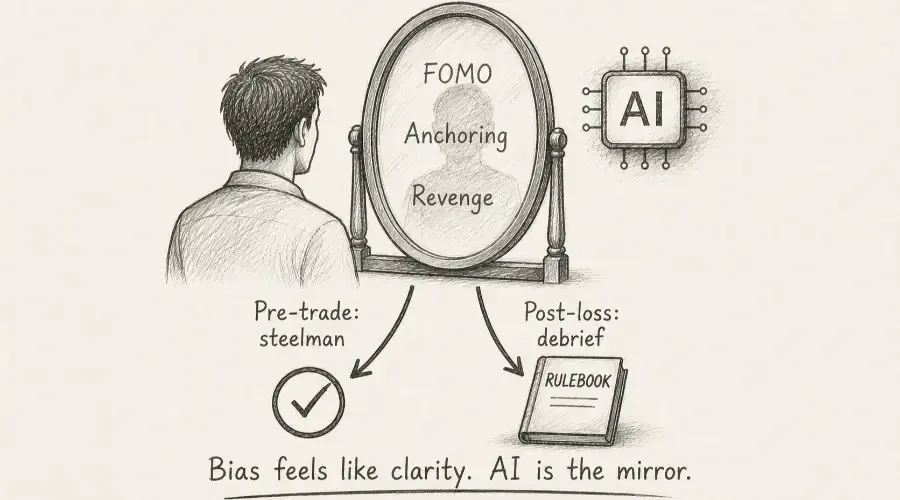
The cruelest thing about cognitive biases in trading is that they feel like clear thinking.
FOMO doesn't announce itself as FOMO – it arrives dressed as opportunity recognition. Anchoring to an entry price doesn't feel like irrationality - it feels like having a principled view on value. Revenge trading after a loss doesn't feel like emotional reaction – it feels like high conviction, sharpened by frustration.
The bias and the rational thought it disguises are neurologically indistinguishable in the moment. That's what makes them dangerous – and why self-assessment of your own biases is so consistently unreliable. You're using the same cognitive machinery to detect biases that produced them.
AI provides an external check - not because it understands trading psychology deeply, but because it reads what you write without emotional investment. It reflects your decision patterns back accurately, without the self-serving interpretation that self-assessment almost always produces.
Trading psychology is the fifth strategy application in the Strategy-Specific Applications with AI hub. It covers why the strategy-AI alignment principle is especially important in the psychology context.
One important caveat first: treat AI's bias labels as hypotheses, not diagnoses. AI can mislabel a pattern - calling legitimate risk management "anchoring," for instance. Verify its assessment against your honest memory of what actually drove the decision before acting on the identification.
Why Self-Assessment of Bias Fails
The fundamental problem is circularity. The bias affects both the decision you're assessing and the assessment itself. A trader who anchored to their entry price when deciding whether to hold a losing position will also anchor to that price when reviewing the decision - concluding the hold was rational because the price "should" have recovered.
Post-trade review done entirely in your own head produces conclusions skewed in a comfortable direction: profitable trades attributed to skill, losing trades attributed to bad luck. AI breaks that circularity by having no stake in making you feel good about what you did.
The Pre-Trade Bias Check – Steelmanning the Opposing View
The highest-leverage moment to catch a bias is before the trade, not after. Once you're in a position, loss aversion, anchoring, and commitment bias all activate to keep you there longer than the thesis warrants.
When to run it: before every trade that exceeds 1% risk. Below that threshold, the friction may outweigh the benefit. At or above it, the cost of a bias-driven entry is significant enough to justify the check.
The steelman prompt:
I'm considering the following trade: [setup, thesis, entry, stop, target].
I believe the trade is worth taking because: [state your reasoning
as specifically as possible].

Steelman the case against this trade as strongly as possible:
(1) List three specific reasons this trade could lose money,
    independent of my reasoning.
(2) Identify the weakest assumption in my thesis – the thing that
    most needs to be true for the trade to work.
(3) Describe the market conditions that would cause the thesis to fail.
(4) Identify any cognitive bias that may be influencing my assessment
    of the setup – based only on the language and reasoning I've used.

Do not validate my thesis. Your job is to be the strongest possible
critic of it. Treat your bias identification as a hypothesis for me
to verify, not a diagnosis.
A trade thesis with genuine edge will survive the steelman – the counterarguments will be weaker than the supporting evidence. A thesis primarily driven by bias will look significantly weaker when its assumptions are challenged explicitly.
Five Cognitive Biases AI Can Help You Identify
The biases that most consistently affect trading have recognisable patterns in the language traders use to describe their reasoning. AI identifies these patterns from your descriptions – not through psychological insight, but because the linguistic markers of specific biases are consistent enough to be identifiable in text.
FOMO – appears as urgency driven by a prior move rather than a current setup. The marker: "the stock has already moved X% and I need to get in before it moves further." This references past performance as the entry rationale rather than current setup quality.
Anchoring – attachment to the original entry price as a reference point for hold or exit decisions. The marker: any reference to "I'm still down X%" as a reason to hold, rather than an assessment of whether the current thesis is intact. The entry price is gone – it is not relevant to the current decision.
Revenge trading – unusually high conviction in a trade taken in the same session as a significant loss. The marker is timing plus certainty language. Revenge trades are described with more confidence than the setup data warrants, and the emotional urgency to recover is being interpreted as trading conviction.
Confirmation bias – selective information gathering where every data point supports the thesis and no counterevidence appears. The marker: a thesis description with no acknowledgment of anything that argues against it. A genuine edge in a complex market almost always has some evidence on the other side.
Overconfidence – the belief that pattern recognition from prior experience guarantees the current trade. The marker: language like "clearly," "obviously," "I've seen this exact setup before, it always works." Overconfidence compresses risk assessment and leads to undersized stops or oversized positions relative to actual setup quality.
The Post-Loss Debrief Prompt
Critical prerequisite: your journal entries must be brutally honest – describe your actual emotional state and reasoning at each decision point, not the reasoning you wish you'd had. AI can only reflect what you tell it. A sanitised account produces a sanitised analysis that confirms what you already believe.
I want an honest bias assessment of the following losing trade.

Entry: [details]
What I was thinking at entry: [honest reasoning and emotional state]
Key decision points during the trade: [moments where I chose to
add, hold, move a stop, or exit late – and what I was thinking]
Exit: [how and why]
Outcome: [P&L]

Identify:
(1) The specific bias most clearly visible in my entry reasoning.
(2) The specific bias most clearly visible in my management decisions.
(3) The moment where addressing a specific bias would have produced
    a different outcome.
(4) One concrete rule change that directly addresses the most
    significant bias you've identified.

Name the bias. Describe how it appeared in my description. Connect
it to the specific decision it affected. Do not soften the assessment.
Flag your identification as a hypothesis for me to verify against
my actual memory of the decisions.
The Sunk Cost Pattern – What a Bias Analysis Actually Produces
A trader entered a mid-cap technology stock at $48 with a stop at $45. A sector peer's guidance revision triggered broad selling – the stock broke through the stop to $44. The trader didn't exit. The reasoning: the sector contagion wasn't company-specific, the fundamentals were intact.
The stock fell to $43. The trader added – better price, same thesis. It fell to $38. They added again. By that point the position was three times its original size, the stop had been breached by nearly 20%, and the average cost had moved to $44. The stock stabilised at $36 and the trader exited – a loss that took six weeks of subsequent profitable trading to recover.
The AI debrief identified two patterns with precision.
The first was the sunk cost fallacy – every adding decision referenced the original entry price as evidence that the current price was attractive. But the relevant question at each decision point was never "is $43 better than $48?" It was "is $43 an attractive standalone entry with a new thesis and a new stop?" That question was never asked. Every decision was anchored to what had already been paid.
The second was a framework switch – the trader had entered on a technical thesis with a defined stop, then abandoned that thesis when the stop was breached and substituted a fundamental hold thesis with no exit mechanism. Both were called "the same decision." They weren't. The trading thesis had failed at $45. The fundamental thesis might justify ownership. But using the fundamental thesis to avoid acknowledging that the trading thesis had failed is not principled holding – it's loss aversion wearing a research hat.
The rule that came out of it: no averaging down on any position that has broken its initial stop level. If the stop is breached, the trading thesis is dead. A new position can be established later with a new entry and a new stop. Adding to a position that has violated its risk parameters is not managing a trade – it's managing a loss by not acknowledging it.
Building a Bias Log Over Time
A single debrief surfaces one pattern. A bias log built across multiple sessions surfaces the patterns that are persistent and systematic – your actual cognitive tendencies across different trades and market conditions, not your beliefs about your tendencies.
When the same bias appears five times in the log across different trades and different market conditions, it stops being situational. It's structural. And structural patterns require structural responses – rules, not renewed intentions.
The path: AI identifies the pattern. The trader creates a rule. The rule enters the pre-trade checklist. The checklist runs before every trade. AI doesn't produce the discipline. It produces the self-knowledge that makes discipline possible – by showing you accurately what your actual patterns are, rather than the ones you believe you have.
Identifying a bias through AI analysis is the first step. Rules are most durable when the strategy they protect has been tested for structural soundness first. How to Backtest a Strategy Idea Using AI covers the logic testing process that validates the strategy the psychological rules are designed to support.
Frequently Asked Questions
Q: What is the most dangerous cognitive bias for retail traders?
Anchoring and sunk cost thinking are consistently the most costly – not because they cause the initial losing trade, but because they prevent exit. A trader who enters badly loses once. A trader who then averages down into a broken thesis, anchored to their original entry price and original thesis, turns a single manageable loss into a position-destroying drawdown. The initial bad entry is a trading cost. The failure to exit when the thesis fails is where accounts are seriously damaged.
Q: How is an AI bias check different from keeping a trading journal?
A traditional trading journal captures what happened. An AI bias check interprets the patterns in what happened – identifying the specific cognitive mechanism that influenced a decision and connecting it to the exact language you used to describe your reasoning. The journal is the data. The AI analysis is the pattern recognition layer applied to it. Most traders who keep journals re-read their own entries through the same biased lens that produced the decisions. AI reads them without that investment.
Q: Can AI identify biases I'm not aware of?
Yes – but with an important qualification. AI can identify patterns in how you describe your reasoning that are consistent with known cognitive biases. Whether those patterns accurately reflect your actual internal state depends entirely on how honestly you've written the description. A trader who writes a polished, post-rationalised account of their decision will get a polished, post-rationalised bias assessment. Brutal honesty in the input is the prerequisite for useful output. Treat every AI bias identification as a hypothesis to verify against your actual memory of the moment – not a definitive diagnosis.