
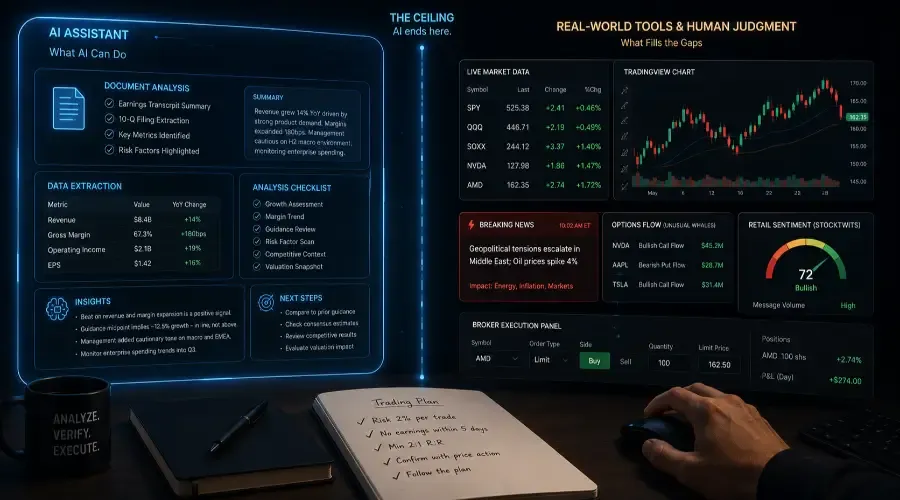
This series has covered macro regime classification, earnings transcript extraction, prompt chaining, personal trading assistants, and tool comparisons. If you've read it in sequence, you're running a more complete AI-assisted trading workflow than the vast majority of retail traders.
Which makes this the right moment to be honest about the ceiling.
AI tools are genuinely powerful for trading research. They also have specific, structural limitations that don't go away with better prompts, smarter chaining, or more refined system prompts. Knowing where the ceiling is – and which tools fill the gaps – separates traders who use AI as a genuine research multiplier from those who over-rely on it in ways that eventually cost them.
No Real-Time Market Data – What Fills This Gap
The most accurate framing: most AI chat tools lack real-time, tick-by-tick market data feeds and cannot replace a dedicated data terminal, even if some can fetch recent web information. Claude has no live market connection. ChatGPT and Gemini can access current web information through browsing and search grounding, but this is web retrieval – not a real-time API-level data feed. Possible latency, inconsistent sourcing, and no streaming quotes mean they cannot substitute for a dedicated data source in a live trading context.
The tools that fill this gap:
Finviz provides real-time pre-market movers, sector ETF performance tables, and screener data. Free tier covers most retail trader needs. TradingView provides live charting and real-time indicator readings – the charting environment where AI analysis gets its source data. Perplexity retrieves and cites current information within minutes of publication, making it the practical Stage 1 data source for the two-stage research workflow (Stage 1: live data retrieval via Perplexity; Stage 2: deep analysis via Claude). Note that Perplexity's indexing is fast but not instantaneous – for breaking news in the seconds after release, a direct source check (BLS page, company IR site) remains the most reliable fallback. Your broker's platform holds everything related to your current positions – live quotes, execution, and real-time P&L.
One data integrity caution that applies across all these sources: if the underlying data source is reporting noise – a fringe financial site misreporting a figure, a social media account spreading an unverified headline – AI will synthesise that noise into a logical-sounding report. Garbage in, garbage out applies regardless of how sophisticated the analytical layer is. Verify figures against primary sources before acting.
Budget baseline for traders managing costs: free TradingView, free Finviz, and Perplexity Pro covers the live data layer adequately for most retail analytical workflows.
No Trade Execution – What Fills This Gap
No standard AI chat tool can place, modify, or cancel trades. The analysis stays in the conversation window. The trade happens elsewhere, manually, through your broker.
For traders wanting actual algorithmic execution, the infrastructure required is entirely different from anything in this series. Brokers with API access – Interactive Brokers being the most widely used among retail algorithmic traders – provide the programmatic connection between a trading system and execution infrastructure. Building on top of a broker API requires either coding skills or a no-code automation platform.
For the majority of traders running discretionary or semi-systematic strategies where a human makes the final decision, this gap is not a workflow problem. The AI analysis informs the decision. The human executes. The gap only becomes a practical problem for traders pursuing full automation – a separate discipline with separate tools.
No Real-Time Sentiment – What Fills This Gap
What retail traders are saying about a stock right now, what options flow looks like this morning, how social media sentiment is trending around a specific name – none of this is accessible to AI chat tools in real time.
The tools that fill this gap: StockTwits for real-time retail sentiment; Unusual Whales, Market Chameleon, and Barchart for live options flow data signalling institutional positioning ahead of catalysts.
One important caution on sentiment data: StockTwits and similar platforms generate significant noise alongside genuine signal. A spike in retail commentary on a name is worth noting – not worth trading on without confirmation from price action, volume, and your own setup criteria. Overtrading based on social sentiment chatter is one of the more reliable ways to underperform. These tools inform awareness; they don't generate entries.
The practical integration: sentiment and flow platforms are Stage 1 data sources alongside Perplexity. They provide live inputs that Stage 2 AI analysis then processes and contextualises against your strategy parameters.
No Reliable Chart Reading – TradingView Remains the Chart Tool
AI tools cannot reliably interpret chart images. The visual-spatial pattern recognition that allows a trained trader to instantly identify a bull flag, read candlestick structure, or assess volume behaviour relative to price is not something large language models do reliably from screenshots.
The chart read is yours. TradingView is the platform where it happens. AI works with data you extract from the chart – the OHLCV table, indicator readings, text description of the structure – not with the chart itself. AI validates the logic of what you see. It does not replace the seeing.
No Guaranteed Accuracy – The Verification Habit Cannot Be Replaced
AI tools hallucinate. They generate confident-sounding incorrect figures, conflate similar numbers within dense financial documents, and produce outdated training data without flagging staleness – all in language that reads as authoritative and precise.
No improvement in model quality eliminates this risk entirely. The verification habit – tracing any specific figure back to its primary source before it informs a trading decision – is the permanent counterbalance. A hallucinated short interest percentage, a misread earnings figure, an incorrect debt covenant threshold – any of these, acted on without verification, produces a trade decision built on a fiction.
For traders managing larger amounts of capital: maintaining an audit trail of human verification decisions is as important as the trade itself. If a trade is later questioned, "the AI said so" is not a defensible position. You made the decision. Document that the verification happened.
The Geopolitical Surprise – What a Claude-Only Workflow Misses
A trader runs their pre-market routine using Claude as the primary research tool, feeding it sector ETF data and pre-market movers sourced manually. The analysis is solid. The watchlist is set.
Twenty minutes before the open, a significant geopolitical development breaks – immediate implications for energy prices, Treasury yields, and risk appetite. Futures reprice in real time. The trader's Claude-only workflow has no way to capture this. The 25-minute briefing is now built on a market picture that no longer exists.
The two-stage trader running Perplexity as Stage 1 surfaces the development within minutes of publication, hands it off to Stage 2 Claude for sector impact assessment, and arrives at market open with an updated analytical framework. Same research sophistication. Different outcome, because one workflow has live data access at the front end.
No Replacement for Experience – But AI Can Accelerate Its Development
AI cannot compress the judgment that comes from time in markets. Recognising when a technically valid setup is in the wrong macro environment, reading the character of a market that's distributing versus building energy, developing the pattern recognition that distinguishes consolidation worth holding from quiet distribution – these are built through experience, real positions, and real discipline failures.
One place where AI actively accelerates this development: post-mortems. After a difficult week, feed your actual trade journal, entry and exit notes, and emotional state records into Claude for pattern identification. AI can surface recurring errors in your process – entries taken on the wrong setup type, position sizing that expanded on losing streaks, sector concentrations that built without noticing – that self-assessment under emotional load tends to miss. The judgment still develops through experience. AI can make the lessons from that experience visible faster.
The Honest Ceiling
AI is a research and analysis multiplier. Not a trading edge by itself. The traders who get the most from it know exactly what it's good at – processing complex documents quickly, enforcing systematic research processes that don't degrade when attention is low, identifying patterns across structured data – and exactly what it cannot do: access live data reliably, execute trades, read charts, guarantee accuracy, or substitute for market judgment.
The workflow this series has built is a genuine research infrastructure upgrade. It makes serious preparation accessible to retail traders in a way that didn't exist before these tools. What it doesn't do is replace any of the things that make a trader actually good at trading. Those things are still yours to build.
Q&A: AI Trading Limitations and Gap-Filling Tools
Q: Can ChatGPT or Gemini replace Perplexity for live market data?
Partially, but not fully. Both can retrieve recent web information through browsing and search grounding – making them more capable for current data than Claude. However, neither provides the citation quality, retrieval freshness for fast-moving releases, or the clean structured output that makes Perplexity the most efficient Stage 1 data source for a trading workflow. For breaking intraday data, a direct source check remains the most reliable approach regardless of which tool you use.
Q: How do I handle AI hallucinations in my research workflow?
The verification habit is the permanent answer: trace every specific figure AI produces back to its primary source before it informs a trading decision. Build this into your prompt templates by requiring the model to flag figures that need external verification. Treat AI output as a first draft that requires confirmation, not a finished analysis. The hallucination risk doesn't disappear with better models – it requires a permanent process response.
Q: Can AI help me develop better trading judgment over time, or does it only support research?
Both. For research, the productivity gains are immediate. For judgment development, the highest-value application is AI-assisted post-mortems: feeding your trade journal, entry/exit notes, and decision records into Claude after difficult periods to surface recurring patterns in your process errors. This doesn't replace the experience of being in markets – but it can make the lessons from that experience visible faster than self-assessment alone.