
Most traders focus their energy on the front end of the trading day. The research, the preparation, the watchlist, the entries. The back end – what happens after the session closes – gets treated as optional. Something to do when there's time, which means something that rarely gets done properly.
This is where most trading improvement actually lives. And it's where most traders leave it.
The post-market review is not a ritual for professionals who have hours to spare. It's the feedback mechanism that turns trading experience into trading improvement. Without it, you repeat the same patterns – the same entry mistakes, the same exit errors, the same emotional responses to the same situations – indefinitely. With it, each session becomes data that makes the next one marginally better. That compounding is where genuine development as a trader comes from.
AI makes this process faster, more structured, and significantly more honest than doing it alone.
Post-market review is Stage 3 of the daily workflow covered in Daily Trading Workflow with AI. If you haven't read the hub overview, it gives you the full picture of how each stage connects.
Why Post-Market Review Is Where Most Traders Improve – Or Fail To
There's a specific reason why post-market review is the highest-leverage improvement habit in trading, and it comes down to how human memory works under conditions of emotional involvement.
When you're in a trade, your attention is not evenly distributed. The emotions attached to an open position – the hope on a winner, the discomfort on a loser – shape what you notice, what you remember, and how you interpret what happened. By the time the session closes, your memory of the day's trading is already being reconstructed through the lens of how it ended.
A trader who had a profitable day tends to remember their decisions as clearer and more deliberate than they were. A trader who had a losing day tends to attribute the losses to market randomness rather than their own choices. Both are doing this unconsciously. Both are building a distorted picture of their own process.
A structured post-market review – run the same way regardless of how the day went, with the same questions asked whether you made money or lost it – creates a record that is harder to distort. Add AI to that process, and you get an analytical layer that has no emotional stake in the outcome. It reads what you wrote. It identifies what the patterns say. It doesn't soften the uncomfortable parts because it has no interest in making you feel better about the day.
That combination – your honest inputs, AI's objective pattern recognition – is what makes the post-market review genuinely useful rather than a journaling exercise that confirms what you already thought.
What to Include in a Post-Market AI Prompt
The quality of the post-market review is entirely determined by the quality of what you put into it. A vague journal entry produces vague pattern recognition. A specific, honest account of what happened and why produces specific, actionable insights.
A Note on Data Privacy: When sharing data with public LLMs, ensure your data privacy settings are maximized (e.g., turning off training history). Never paste sensitive personal financial details, actual broker account numbers, or API keys into the prompt. Stick strictly to tickers, percentages, execution metrics, and psychological notes.
For each trade taken during the session, your post-market prompt should include:
The trade details
Ticker, entry price, exit price, position size, direction (long or short), holding time. These are the objective facts. They should be stated precisely, not estimated.
The pre-trade reasoning
What was the thesis? Why did you enter at that price, at that time? What setup or signal triggered the entry? This is where honesty matters most – write what you were actually thinking, not what sounds like a good reason in retrospect.
The execution
Did you follow your plan? Did you size the position according to your rules? Did you enter at the level you intended, or did you chase? Did you exit at your target or stop, or did you deviate?
The outcome
Win or loss, and by how much relative to your target and stop. Not just the dollar figure – the result relative to what you planned.
Market conditions at the time
What was the broader market doing when you entered? Was the sector supporting or contradicting the trade? Were there any macro events active during your holding period?
Your emotional state
This is the element most traders omit, and it's often the most informative. Do not simply write "I was emotional." Be specific and descriptive.
Example: "Felt anxious after the earlier morning loss; entered this trade with less conviction than usual, which caused me to fiddle with my stop loss prematurely."
Together, these inputs give AI something real to work with – not just the outcome of your trading, but the process and context that produced it.
How AI Helps Identify Patterns in Your Decision-Making
The most valuable thing AI does in the post-market review is not summarise what happened. It's identify patterns across multiple sessions that your own perspective cannot reliably see.
This works because the AI is reading your inputs analytically, without the emotional context that shaped them.
When you describe a trade where you held too long and gave back profits, you may frame it as a difficult market day. The AI reads the same account and identifies it as the fourth time in six sessions you've held past your target in a winning trade – a pattern that your session-by-session view obscured because each individual instance felt like a unique situation.
That's the specific value: pattern recognition at scale, across a body of evidence that your own memory systematically distorts.
Common patterns that AI reliably surfaces across trading journal entries:
Entry timing relative to events
If you consistently enter trades within minutes of a scheduled macro release, AI will notice this across multiple entries – even if you haven't consciously tracked it. The pattern becomes visible in the aggregate even when individual entries seemed reasonable in the moment.
Position sizing drift
Traders who have a defined risk rule – 1 to 2% per trade, for example – often drift gradually away from it under specific conditions: after a winning streak, after a losing streak, or in high-momentum environments. AI reading a week of trade data will identify this drift from the numbers precisely.
Holding time inconsistency
Many traders have a stated holding period but an actual holding period that varies dramatically depending on how the trade is going. AI can identify whether you consistently exit winners early and hold losers long – the most common expression of loss aversion in trading behaviour – from a few sessions of honest data.
Emotional state correlation
When you include your emotional state in each entry, AI can identify whether your worst trades cluster around specific emotional conditions. Revenge trading after a stop-out, overconfidence after a strong run, hesitation in entry after a recent loss – these patterns are consistent enough across traders that they're almost always present, but almost never visible without a systematic review.
The cognitive biases that surface in post-market journal entries - anchoring, FOMO, sunk cost are covered in practical depth in How to Use AI for Trading Psychology and Bias Checks, which shows how to run a pre-trade bias check and structure a post-loss debrief that produces honest pattern recognition.
The Difference Between an AI-Assisted Journal and a Plain Journal
A plain trading journal records what happened. An AI-assisted journal analyses what the record reveals. Both require the same honest inputs. The difference is what you do with them.
A plain journal is only as useful as your ability to analyse your own patterns objectively – which, as discussed, is systematically compromised by the same biases that produced the trades you're reviewing. You can write pages of daily entries and still miss the most important patterns because they're distributed across sessions in a way that's invisible to session-by-session reflection.
An AI-assisted journal uses those same entries as inputs for pattern analysis that operates across sessions and across time. The AI doesn't read your Monday entry in isolation. It reads Monday, Tuesday, Wednesday, Thursday, and Friday together, and it identifies what the week reveals about your process – not just what each day felt like individually.
This is why the post-market journal is most valuable as a cumulative document rather than a daily task. Each entry adds to the record.
A Template for a Post-Market AI Journaling Prompt
This template is a starting framework. Adapt it to your strategy, your timeframe, and the specific patterns you're trying to track.
Plaintext
"Act as a trading coach reviewing my session journal entries. I'm going to describe my trades from today, my reasoning, my execution, and my emotional state. Your task is to:
(1) Identify any patterns in my decision-making that are consistent with known cognitive biases – name the bias, describe how it appeared, and give the specific example from today's entry.
(2) Assess whether my execution matched my stated pre-trade plan – identify any deviations and describe what they suggest about my process.
(3) Flag any risk management issues – position sizing, stop placement, holding time – that deviate from the rules I'll describe below.
(4) State one specific behavioral marker or dynamic I should monitor for pattern confirmation across the next few sessions based on today's performance.
My trading rules for reference: [state your key rules – risk per trade, entry criteria, exit criteria, holding period].
Today's session: [paste your trade details, reasoning, execution notes, outcome, market conditions, and emotional state for each trade]."
The final adjustment rule in this prompt is deliberately calibrated. A single session rarely provides enough data to justify rewriting your entire trading plan; over-adjusting rules daily based on a single erratic session is a trap that creates strategic inconsistency. Instead, use daily feedback to highlight what to monitor, and save structural rule updates for the cumulative weekly review.
How to Use AI to Spot Recurring Mistakes Without Self-Deception
Self-deception in trading review is not dishonesty. It's the natural output of reviewing your own performance with the same cognitive machinery that produced the performance being reviewed.
The most effective defence against this is structured inputs – writing your journal entries with specific, objective fields rather than a narrative that allows the emotional framing to shape what gets recorded. When you record entry price, exit price, position size, and deviation from plan as discrete fields rather than embedded in a story about the day, the data is harder to unconsciously edit.
The second defence is asking AI directly to steelman the uncomfortable interpretation. After a losing session where you've written a journal entry, add this to your prompt:
"Based on my description of today's trades, what's the most honest explanation for the outcome – one that doesn't rely on market randomness or bad luck?"
That question invites the model to produce the interpretation you're most likely to resist – which is often the most useful one. It doesn't mean the honest interpretation is always that you made mistakes. Sometimes the market genuinely was random and your process was sound. But the question ensures you've at least considered the alternative before concluding that.
The NVDA Trade – What an AI-Assisted Review Looks Like
Here's a concrete example of the post-market review process in action.
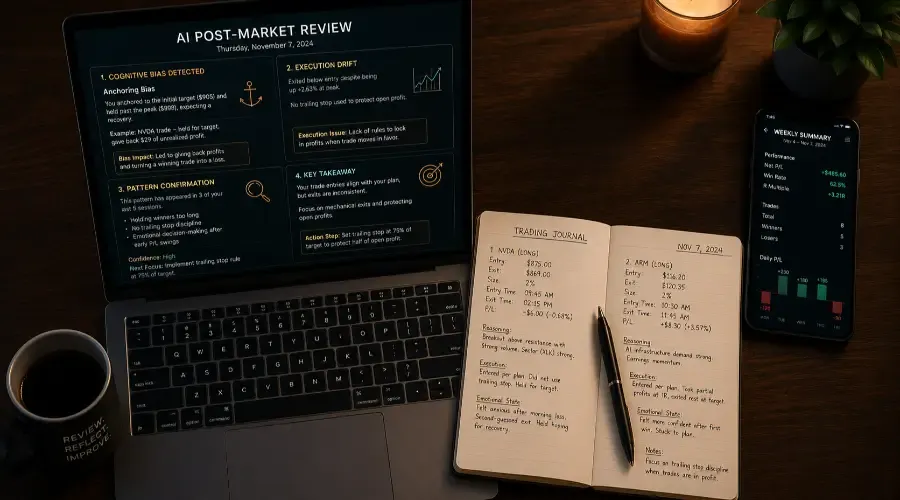
A trader bought NVDA on a morning breakout above a key resistance level. The setup was clean – volume confirmation, broader market supportive, sector momentum aligned. Entry at 875, stop at 858, initial target at $905.
NVDA ran to $898 within two hours. The trader didn't exit. The reasoning, written in their journal that evening: "I felt the momentum was strong and wanted to give it room to reach the full target."
NVDA then reversed. The trader still didn't exit. New reasoning: "I was anchored to the 905 target and kept expecting it to recover. "By the time they exited,the stock had retraced to 869 – a small loss on a trade that had been up $23 at its peak.
The journal entry for that evening included all of this honestly – the entry, the peak, the reversal, the exit, and the reasoning at each stage.
The post-market AI prompt asked the model to identify the decision pattern. The output identified two things precisely:
Anchoring Bias
Anchoring to the original entry price and target created a reluctance to take profits at $898 despite the trade being within a fraction of the stated target. The model named this as anchoring – the cognitive bias where an initial reference point exerts disproportionate influence over subsequent decisions, even when circumstances have changed.
Execution Drift
The exit at $869 represented a loss relative to entry, but the more significant failure was the exit relative to the peak. The model highlighted the absence of a trailing stop discipline rule to lock in profit as a trade moves heavily in favor.
Because this exact behavior had been flagged by the AI as a recurring focus point over three previous sessions that week, the cumulative data made the conclusion undeniable. The trader implemented a new rule: Any trade that reaches 75% of the target price gets a mandatory trailing stop set to protect half the open profit. The insight changed the next trade.
Building the Habit That Compounds
The post-market review is the kind of habit that produces almost no visible return in the first week and significant return over three months. Each individual session adds a small data point. The pattern recognition that emerges from thirty sessions of honest entries is qualitatively different from anything a single review can produce.
The practical requirements to make the habit sustainable:
Keep the time commitment realistic
A complete post-market AI session – writing the journal entries, running the prompt, reading the output – takes 15 to 20 minutes. That's the target. A process that takes 45 minutes will get skipped on difficult days.
Run it the same way regardless of the day's outcome
Good days contain the seeds of future bad ones – position sizing drift, rule deviations that happened to work out, entries that were rushed but got lucky.
Store the outputs for the weekly review loop
Daily review catches individual session errors. Weekly review catches the patterns across sessions that daily review can't see. How to Use AI for End-of-Week Portfolio Review covers the aggregate analysis - win rate, expectancy, position sizing consistency - that turns a week of journal entries into a single actionable process adjustment.
The post-market review is where the daily workflow closes. It's also where the next session's preparation begins – because what you identify tonight shapes what you watch for tomorrow.
Trading Journal & AI Review: Frequently Asked Questions
How does an AI trading journal improve trading psychology?
An AI trading journal acts as an objective, emotionless mirror. Human traders naturally suffer from self-deception–rationalizing losses as "bad luck" and wins as "pure skill." AI analyzes your text and metrics without an emotional stake, identifying cognitive biases like anchoring, FOMO, or loss aversion by finding patterns across multiple entries that you might consciously ignore.
Can I copy-paste my raw broker ledger into an AI prompt?
While you can paste basic execution data (tickers, prices, entry/exit times), doing so without adding context severely limits the AI's utility. An effective AI-assisted post-market review requires a blend of hard data and behavioral metadata–specifically your pre-trade reasoning and exact emotional state during the trade execution.
What is the biggest mistake traders make when journaling with AI?
The biggest mistake is over-adjusting trading strategies based on a single session's AI feedback. A single day's trading does not provide a statistically valid sample size. Daily AI reviews should be used to flag behaviors to monitor. Permanent adjustments to your mechanical trading plan or risk management rules should only be made during a cumulative weekly or monthly review.