
Trading analysis and trading content are not the same thing.
Analysis is what you produce for yourself – structured, precise, calibrated to your strategy. It can be rough at the edges, shorthand where context is shared, formatted for the single reader who already knows what the terms mean.
Content is what you produce for others – a market analysis report, a sector brief, a daily newsletter, an educational post about a trading concept. It needs to withstand scrutiny from readers who will fact-check specific claims. It needs a consistent voice your audience recognises across issues. It needs educational framing that keeps it clearly separate from investment advice. And it needs a production process reliable enough to publish on schedule without sacrificing quality.
AI handles these two tasks differently. For personal analysis, AI is a research tool – the frameworks in this series apply directly. For AI-assisted financial content creation, AI is a drafting and synthesis tool that requires a more careful production process, a stricter verification layer, and a human editing pass that is non-negotiable before anything is published.
Why Content Creation Requires Different Prompts
When you produce analysis for your own trading, you can catch imprecision before it informs a decision. When you produce content for others, readers receive the output after editing and formatting, without visibility into the research process. They may read a specific figure and act on it. They may interpret confident language as a recommendation rather than an educational observation.
Three adjustments follow from this.
The framing shift
Personal analysis can be framed any way that's useful to the analyst. Published content must be framed consistently as educational – describing what traders typically look at, how market participants generally interpret a setup, what an indicator historically suggests – rather than as directional recommendations. This isn't just legal protection. It's an honest reflection of what AI-assisted analysis can and cannot provide. Educational framing as a default also improves the quality of the reader relationship: it shifts expectations from "give me a trade signal" to "teach me how to read the market."
The voice consistency requirement
AI output without voice calibration produces text that's technically accurate but tonally generic. Building voice parameters into a dedicated content Project system prompt – separate from your personal analysis Project – is what maintains the consistency published content requires. Upload three to five of your best-performing past pieces as style examples, and add specific do's and don'ts based on your post-editing observations over time.
The accuracy standard
In personal analysis, a misread number is caught in verification before it informs a trade. In published content, it reaches readers first. The verification layer for content creation is more rigorous, not less, than for personal analysis.
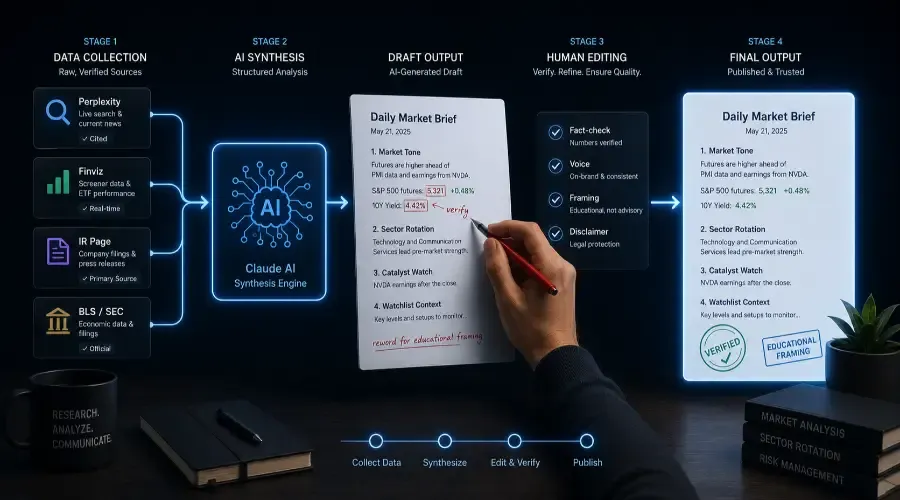
The Four-Stage Report Workflow
The market analysis report – a regular brief covering macro conditions, sector rotation, and specific setups – follows the same production structure regardless of format or frequency.
Stage 1 – Data Collection
This is the two-stage research system applied to content production: Perplexity for current market data, economic releases, and overnight developments; Finviz for sector ETF performance tables; company IR pages and SEC EDGAR for company-specific material. Everything that enters the report starts as a verified fact from an authoritative source.
One critical discipline at this stage: don't rely solely on the citation. Perplexity cites sources reliably, but citations can link to summaries that themselves contain errors, or to pages that have since been updated. Spot-check key figures – particularly earnings data and economic releases – directly against the primary source (BLS page, company IR press release) before passing them to Stage 2. The citation is a pointer, not a guarantee.
Stage 2 – AI Synthesis
Claude processes the collected, verified data into structured analytical sections. The prompt is calibrated for report output: educational framing, output sections that map to the report's standard structure, and voice parameters from the content Project system prompt. The two-stage approach means Claude is working from data you've already verified at the source – minimising the garbage-in risk that undermines AI-assisted financial content production.
Stage 3 – Human Editing
The AI draft is read critically. Every specific number is checked against the Stage 1 source data. Framing is reviewed for accuracy and for appropriate educational positioning – any sentence that implies a recommendation is rewritten as a description. Voice consistency is assessed, with adjustments to any passage that has drifted into generic AI register. The legal disclaimer is confirmed.
Stage 4 – Output
The edited, verified report is formatted and published.
Stage 3 is not optional polish. It's the stage that makes the output trustworthy. AI synthesis produces a draft. Human judgment produces the report.
The BreakoutBulletin Workflow in Practice
Here's what this looks like applied to a professional trading education operation running a daily pre-market intelligence brief.
Stage 1 takes approximately 20 minutes: three targeted Perplexity searches covering overnight futures, the economic calendar, and any significant overnight earnings or developments. Sector ETF performance table pulled from Finviz. Any earnings figures verified directly against the company's IR press release before being passed forward.
Stage 2 takes approximately 15 minutes: verified data structured into a formatted input and passed to Claude via the content Project – the Project whose system prompt captures BreakoutBulletin's voice, the educational framing default, and the brief's four-section output structure (market tone, sector rotation, catalyst analysis, session watchlist context).
Stage 3 takes approximately 12 minutes: sequential read against source data with a checkmark on each verified figure, framing review for advisory language, voice assessment with minor adjustments, disclaimer confirmation.
Total: 47 minutes for a complete daily market intelligence brief. The equivalent produced entirely manually previously took approximately 90 minutes. The 43-minute daily saving represents roughly 180 hours annually at a five-day publishing schedule – returned to higher-leverage work while output quality is higher and more consistent.
Maintaining Accuracy and Voice Over Time
Two elements determine whether AI-assisted content maintains quality as the operation scales.
The accuracy infrastructure rests on source discipline at Stage 1 and systematic fact-checking at Stage 3. Every specific number in published content must be verified before publication – not sampled, every number. The best Stage 3 is the one that rarely catches errors because Stage 1 data was already verified at the source.
The voice system is maintained through the content Project system prompt, refined over time. Each time AI output requires a voice adjustment in Stage 3, identify precisely what changed and add it to the system prompt as a specific instruction. Over months, the first draft increasingly requires no voice adjustment at all.
One additional maintenance practice worth building in: periodically rotate the opening structure or section order of the brief – every four to six weeks – to prevent formulaic repetition that regular readers notice even when individual content is accurate and well-framed. Even a well-calibrated system prompt can produce structural predictability over time that a minor variation resets.
Legal Framing and Transparency
Every piece of trading content should be framed as educational throughout the body – not just covered by a footer disclaimer.
Educational: "When a company beats EPS estimates by more than 5%, traders typically see the stock gap higher at the open. Whether that gap sustains often depends on the guidance direction."
Advisory: "If Company X beats estimates tomorrow, you should consider buying the stock at the open."
Building educational framing as a system prompt default ensures AI output describes rather than prescribes. The human editing pass then reviews for advisory language the AI introduced despite the instruction.
Standard disclaimer for every piece of trading content: "This content is for educational purposes only. Nothing in this publication constitutes investment advice or a recommendation to buy or sell any security. Consult a qualified financial advisor before making investment decisions." This disclaimer is a starting point – consult a qualified professional to confirm it fits your jurisdiction and business model, particularly if you monetise content or offer subscription services.
On AI disclosure: the publishing landscape is moving toward transparency norms. A brief acknowledgment that AI tools assist in research synthesis and drafting – while editorial judgment, verification, and final content decisions remain human – is increasingly the credibility-preserving position. Readers value the insight and judgment you bring; disclosing the drafting tool doesn't diminish that, and attempting to obscure it creates unnecessary risk as AI detection tools improve.
A Final Note
This is the last post in a series of 44. Across every hub – macro regime classification, earnings analysis, prompt engineering, personal trading assistants, tool comparisons – one distinction has appeared in every post and belongs in this one too.
AI is a research and analysis multiplier. It is not a source of trading recommendations, a predictor of market direction, or a substitute for human judgment.
The value AI provides in content creation is real. The speed it adds to production is genuine. The consistency it brings to analytical processes is measurable. And none of it changes the fundamental character of what these tools are: drafting infrastructure that makes the actual value – your analytical framework, your editorial judgment, your voice built through years of publishing – accessible more consistently and more efficiently than it was before.
Build the infrastructure. Develop the edge. Know the difference between them.
Q&A: AI-Assisted Financial Content Creation
Q: Does using AI to write financial content impact my credibility?
Only if you treat it as an author rather than a drafting assistant. AI synthesises verified data into structured drafts efficiently. Human editing ensures accuracy, voice, and judgment. That combination produces authoritative output – the credibility risk comes from skipping the human layer, not from using AI in the pipeline.
Q: What is the most common mistake when automating financial newsletters?
The black box trap: accepting an AI draft without checking the underlying figures against primary sources. The AI's logic may sound coherent while a specific earnings date or EPS figure is hallucinated. The non-negotiable rule is: if the figure didn't come from a source you verified yourself, verify it before publishing.
Q: How do I distinguish educational content from investment advice?
Framing. Investment advice is prescriptive – "you should buy X." Educational content is descriptive – "traders typically monitor X for confirmation of Y." Building educational framing into your system prompt shifts AI output toward objective observation by default, which is both the safer compliance position and the higher-quality reader relationship.
Q: How do I maintain a consistent voice when using AI to write?
Use a dedicated content Claude Project with a system prompt that captures your publication's register, vocabulary conventions, and sentence structure tendencies. Upload three to five of your best-performing past pieces as style examples and add specific do's and don'ts based on your post-editing observations. Voice calibration improves with each refinement until first drafts require minimal adjustment.