
5 Valuation Traps Every Retail Investor Must Understand in 2026
Breakout Bulletin | March 2026 | Analysis by the BreakoutBulletin Editorial Team
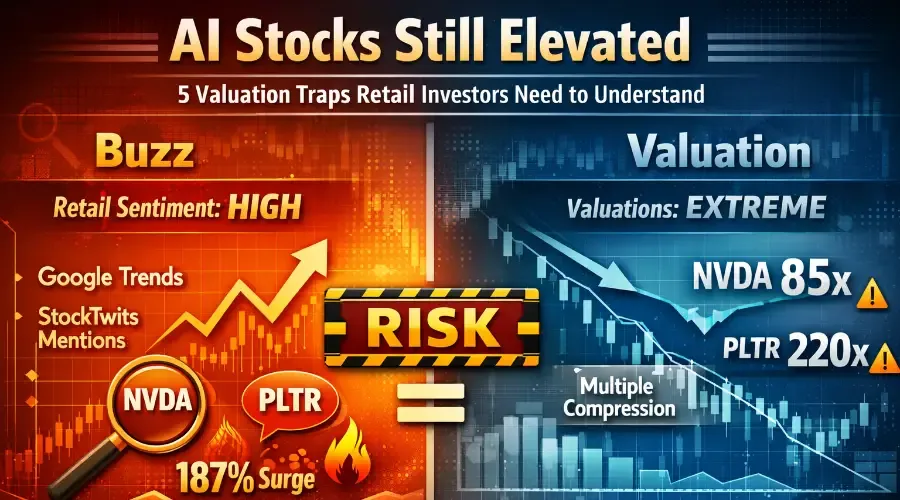
Retail interest in AI stocks has surged sharply in March 2026, but rising search activity does not necessarily indicate attractive valuations. Queries like “best AI stocks 2026” are up 42% month-on-month, while names like Nvidia (NVDA) and Palantir (PLTR) are trading at historically elevated multiples.
In practical terms, the gap between retail enthusiasm and valuation reality is where risk begins to build.
The Buzz: What Retail Data Is Signaling
Search and social data show a clear concentration of attention in AI. Google Trends scores for AI-related queries reached peak levels early in March, sustaining elevated levels through mid-month. At the same time, “Nvidia AGI” searches surged 187% within 48 hours, while AI-related mentions on StockTwits reached 2.3 million in a single week.
This matters because high retail attention has historically been associated with crowded positioning and elevated volatility, not necessarily continued price gains. During past cycles like 2021 EV and meme stocks, the most talked-about names underperformed over the following months. The direction of markets depends on whether fundamentals justify the attention already priced in.
The Valuation Reality: Five Key AI Names
The current AI landscape is defined by a disconnect between buzz levels and valuation multiples. It is also important to recognize that AI stocks span different sub-sectors, each with a distinct risk profile.
Nvidia (NVDA) trades at approximately 85x forward earnings, above its historical peak near 60x.
AMD trades around 65x forward earnings, reflecting aggressive AI chip expectations.
Palantir (PLTR) trades near 220x trailing sales, with no clear precedent in software history.
Microsoft (MSFT) trades at roughly 42x forward earnings, supported by Azure AI growth.
Alphabet (GOOGL) trades near 28x forward earnings, making it the lowest multiple among the group.
The implication is clear: investors are paying a significant premium for AI exposure, and the justification for that premium depends on sustained execution.
The Critical Case: Palantir’s Valuation Extremes
Palantir’s ~220x sales multiple stands out as historically extreme. The closest comparable, Snowflake, peaked around 50x sales before experiencing a drawdown exceeding 70%.
Palantir’s valuation implies sustained 30%+ revenue growth over many years—an expectation that leaves little margin for error.
This highlights a key principle: valuation reflects expectations, not certainty. When multiples reach extremes, even small execution gaps can trigger sharp repricing, as seen in Palantir’s ~40% drawdown in February 2026, driven by multiple compression rather than business deterioration.
Three Retail Pitfalls in the Current Cycle
1. Chasing Headlines Instead of Fundamentals
Following high-profile AI commentary, Nvidia rose approximately 12%, only to give back around 8% as the market reassessed the information.
The key takeaway is that price often moves ahead of narrative confirmation, not after it.
2. Crowding into the Same Names
During the week of March 20, 8 of the top 10 most-mentioned stocks on StockTwits were AI-related.
This concentration creates liquidity risk, where shifts in sentiment can lead to sharper downside moves. A historical parallel can be drawn to Cisco in 2000, where extreme valuations led to prolonged underperformance.
3. Ignoring Valuation Anchors
Palantir’s ~40% drawdown occurred without a change in its business trajectory.
The move was driven by multiple compression, not fundamentals—highlighting how valuation alone can drive price declines.
The Framework: Matching Buzz with Valuation
A structured way to analyze AI stocks is to align sentiment with valuation context.
High buzz + reasonable valuation → momentum can continue, but expectations are elevated.
High buzz + extreme valuation → historically linked to higher drawdown risk.
Low buzz + reasonable valuation → more stable, fundamentals-driven performance.
Low buzz + extreme valuation → often precedes rotation out.
Applied today, Nvidia and Palantir fall into the high-buzz, high-valuation category, which carries elevated downside risk if expectations are not met.
A Practical Approach to Evaluating AI Stocks
A three-step process helps separate signal from noise.
First, measure sentiment using search and social data as a gauge—not a signal.
Second, compare valuation multiples to historical ranges and peers.
Third, identify catalysts such as earnings and revenue trends that can justify current pricing.
The key point: earnings data, not narratives, drive sustained valuation changes.
What to Watch Next
Nvidia earnings (May 21) and hyperscaler capex guidance
AI infrastructure spending trends from Microsoft, Google, and Amazon
Revenue growth trajectories across AI-linked companies
Margin stability in high-growth segments
These data points will determine whether current valuations are validated—or reset.
FAQ
Is Nvidia (NVDA) overvalued at 85x forward earnings?
At 85x, Nvidia is trading above its historical peak. Whether this is justified depends on continued growth and margin strength. A slowdown could lead to multiple compression even without business deterioration.
Why is Palantir’s valuation considered extreme?
A ~220x sales multiple implies near-perfect execution over many years. Historically, even high-growth companies like Snowflake peaked far lower before significant corrections.
How can investors distinguish AI buzz from real value?
High search and social activity indicate attention, not value. True assessment comes from earnings growth, margins, and capital allocation trends.
What could trigger a sector-wide AI correction?
A reduction in hyperscaler capital expenditure or a shift in interest rate expectations could lead to broad multiple compression across AI stocks.
Structural Takeaway
The current AI cycle is defined by a divergence between attention and valuation.
High search interest tells you where attention is concentrated. Valuation tells you what price that attention has already been paid at.
In practical terms, the key question is not whether AI is a long-term opportunity, but whether current prices already reflect that opportunity.
Disclaimer
This article is for informational and educational purposes only and does not constitute financial, investment, or trading advice. You are solely responsible for your own investment decisions and should consult a licensed financial professional before acting on any information in this post.