
AI Infrastructure & Physical Constraints
By Manish T. · BreakoutBulletin
The AI supply story has been told one bottleneck at a time.
First it was GPUs–not enough compute.
Then memory - the RAM being drained and repriced.
Then advanced packaging–the step that assembles the chip.
But suppose, for a moment, that all three get solved.
You have your accelerator, its memory, and a packaging slot.
You still have to plug it in.
That last step turns out to be the hardest of all.
A modern AI campus draws the power of a small city, and the thing standing between it and the grid–an interconnection queue, a transmission line, a high-voltage transformer–runs on timelines measured in years, sometimes a decade.
Somewhere around 2025, the industry's binding constraint quietly migrated from the server rack to the substation.
Power is now the primary limit on how fast AI infrastructure can be built, and it's the one constraint you cannot buy your way past on any near-term schedule.
The Scale of the Demand
Start with how much electricity this actually takes, because the numbers reset your sense of scale.
Data centers were a rounding error in national power demand a few years ago–roughly 4.4% of U.S. electricity in 2023.
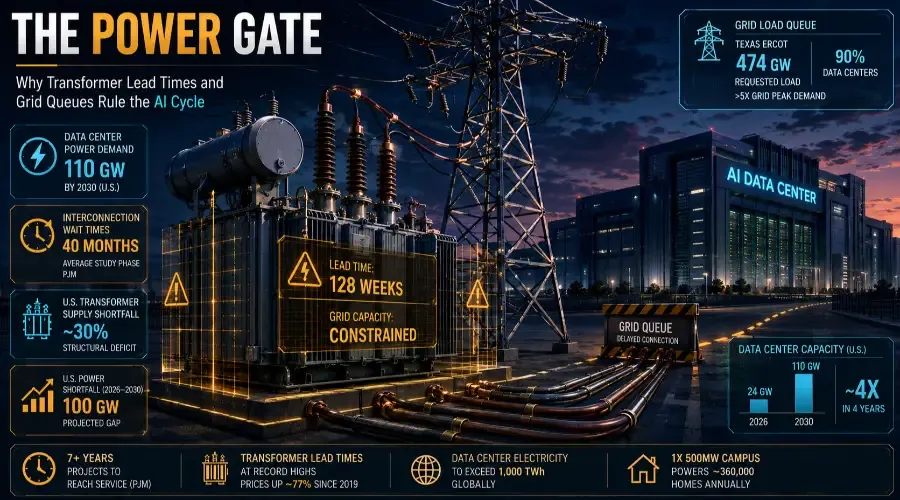
That share is climbing fast, and the capacity math is stark: U.S. data-center capacity is projected to grow from around 24 gigawatts in 2026 to roughly 110 gigawatts by 2030–a near-quadrupling in four years.
A single 500-megawatt AI campus running near full utilization consumes close to 3.9 terawatt-hours a year–about the annual electricity use of 360,000 homes.
Globally, the International Energy Agency expects data-center electricity consumption to pass 1,000 terawatt-hours, up from 460 in 2022.
This is no longer a facilities line item.
It's a load large enough to reshape entire regional grids.
Bank of America projects an even starker gap: between 2026 and 2030, the U.S. could face a 100-gigawatt electricity generation shortfall, with capacity demand expected to reach 230 gigawatts or more while utilities are only projected to deliver about 93 gigawatts.
That's not a tight market–that's a structural crisis in the making.
Why the Grid Can't Keep Up: Generation vs. Load Queues
The first wall is getting permission to connect at all–a structural crisis occurring simultaneously on both sides of the meter.
To understand the grid's gridlock, it helps to separate generation queues (power trying to get onto the grid) from load queues (data centers trying to pull power off the grid):
Supply/Generation Queues: Across the U.S., roughly 2,000 gigawatts of generation and storage sit in interconnection queues–more than the entire installed capacity of the country–waiting for the studies and approvals needed to feed power into the system. However, most of that queue will never be built: of the capacity that entered queues between 2000 and 2018, only about 19% of projects (14% of total capacity) reached commercial operations by the end of 2023.
Demand/Load Queues: On the other side, grid operators are overwhelmed by massive load requests from hyperscalers. In Texas alone, ERCOT is tracking over 474 gigawatts of requested load–more than five times the grid's record peak demand–with 90% attributed to data centers.
This creates a severe double-sided mismatch: new energy generation cannot connect fast enough to supply the grid, while new data center campuses cannot get approval to pull load from it.
Clearing paper queues no longer solves the problem.
PJM, the largest U.S. grid operator, reports that projects reaching service in 2025 took more than seven years end to end.
Typical interconnection wait times in PJM average 40 months just for the initial study phase.
The bottleneck has shifted downstream from paperwork to physical execution: transmission corridors, substation capacity, and high-voltage electrical hardware.
The Bottleneck Behind the Bottleneck: Transformers
That hardware is the quietest and most acute chokepoint of all.
Large power transformers–the refrigerator-to-house-sized units that step voltage up for transmission and back down for use–now carry record lead times.
Prices have risen about 77% since 2019, and the market is running a supply shortfall estimated near 30% for power transformers.
| Equipment / Grid Metric | Lead Time / Stat | Market Impact |
|---|---|---|
| Power Transformers | ~128 Weeks | ~30% Structural Supply Deficit |
| Generator Step-Up (GSU) Units | ~144 Weeks | Generation Connection Delays |
| PJM Interconnection Queue | ~40 Months (Study Phase) | 7–8 Year Total Project Lifecycle |
| 2026 Data Center Buildout | 33% Active Construction | ~7–8 GW Delayed or Canceled |