
Market Structure & Capital Flows
By Manish T. · BreakoutBulletin
The AI build-out is usually described as if the mega-cap technology companies are funding it out of enormous cash flows, balance sheets pristine, debt minimal. That picture is increasingly wrong, and the gap between it and reality is one of the most important and least understood stories in the market right now.
A large and growing share of the hundreds of billions flowing into AI data centers is being financed with debt that never appears on the hyperscalers’ balance sheets in the way conventional borrowings do. According to a comprehensive estimate from Bank of America Global Research, the hidden obligations across the five biggest names add up to roughly $1.65 trillion. The Bank for International Settlements has a blunt name for the practice: shadow borrowing. The debt you can see in the headlines is only part of the story, and it may be the smaller part.
How the Debt Disappears
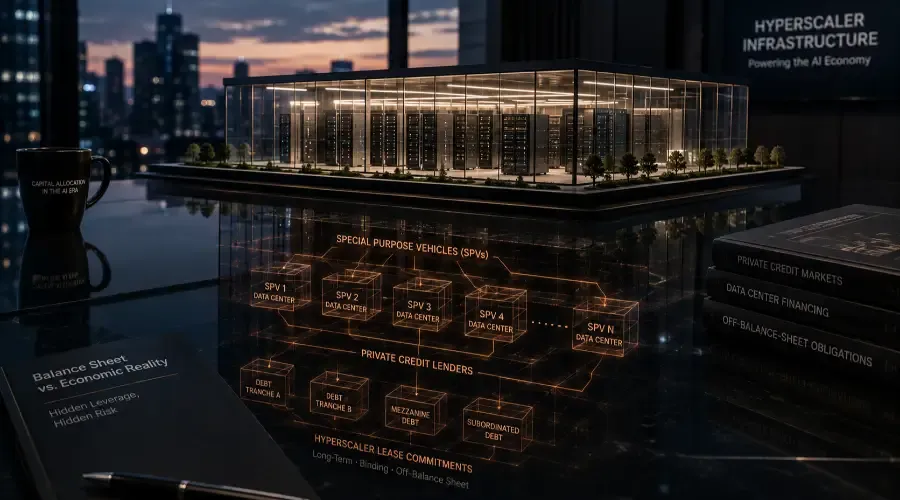
The mechanism is legal, common, and quietly powerful. Instead of borrowing money directly—which would show up as debt and pressure leverage ratios and credit ratings—a hyperscaler helps set up a separate special purpose vehicle, usually alongside a private credit or private equity partner. That vehicle borrows the money and builds the data center. The hyperscaler then signs a long-term contract to use it, committing to years of binding payments.
Under accounting rules, many long-term leases do appear on balance sheets as right-of-use assets and lease liabilities. But the off-balance-sheet treatment for these AI data-center SPVs often relies on a different route: the structures are designed to avoid consolidation under variable interest entity rules, and residual-value guarantees or purchase options can keep key obligations in the footnotes rather than on the face of the balance sheet. The company gets its computing capacity, but its reported debt barely moves. In economic substance, the company has borrowed billions. In accounting form, the liability is either absent or heavily diluted. Rating agencies and investors are left to piece the full picture together from disclosures that were never designed to capture this kind of financing at scale.
The Scale of What’s Off the Books
The numbers are large enough to change how you read the entire sector. Companies have moved more than $120 billion of data-center spending off their balance sheets through these structures in roughly eighteen months, and the cumulative hidden obligations run far higher.
Meta’s Hyperion facility in Louisiana was financed through a roughly $30 billion SPV backed by private credit, one of the largest such deals on record. Its multi-billion-dollar residual-value guarantee appears only in a footnote to the annual report rather than as a recorded liability. Alphabet, long regarded as the hyperscaler with the cleanest balance sheet, has disclosed more than $40 billion in future funding commitments to off-balance-sheet vehicles. Oracle’s data centers for its largest AI customer are built and held inside vehicles financed with tens of billions in private-credit debt and leased back. The heaviest users of these structures include Meta and Oracle, while others like Microsoft have been more measured—a distinction lost in broad-brush sector commentary.
Even among the more conservative names, the logic is nearly irresistible: fund the build-out, keep the leverage invisible.
Who’s Actually Lending
This is also the story of where the money comes from, and the answer is increasingly not the public bond market. Private credit funds—including Blackstone, Blue Owl, Apollo, Pimco, and BlackRock—now originate most of the debt behind AI data centers, both through these off-balance-sheet vehicles and through direct loans to developers. Their lending to AI-related infrastructure has surged from near zero to well over $200 billion in just a few years. Morgan Stanley projects private credit will supply another $800 billion of data-center financing over the next two years.
The significance is that public bonds are visible and repriced every day, while private credit is opaque and marked infrequently. As the funding of the AI boom migrates from the first toward the second, the true cost and true scale of the leverage become progressively harder for anyone outside the deal to see. If private-credit marks were to come under pressure, some of the largest lenders are themselves publicly traded or manage products with redemption features, creating a potential channel for stress to leak into public markets.
Where the Cushions Are Thin
The concern is not that off-balance-sheet financing is improper; it is a legitimate, long-established tool. The concern is what it obscures. When a company’s reported leverage looks modest while its true obligations are far larger, investors, rating agencies, and regulators are all working from an understated picture of the risk.
Moody’s has warned directly that hyperscaler disclosures “may not show the full picture,” because the combination of short initial lease terms and residual-value guarantees can leave reported liabilities materially understating what companies actually owe. On visible measures, hyperscaler leverage has already roughly doubled; the hidden measures push it higher still.
And the equity cushions inside some of these structures are thin. Certain deals are reportedly structured with as little as 10% equity, meaning a relatively modest shortfall in lease payments could wipe out the equity buffer and transfer stress directly to lenders. A small disappointment in the underlying economics can have consequences out of proportion to its size.
The Historical Rhyme
There is a parallel that should focus the mind, because it ended badly. In the late 1990s and early 2000s, telecom-equipment makers financed the internet companies buying their gear—a form of vendor financing that let the buildout run far ahead of real demand. It worked until demand growth stopped outrunning the debt, and then the entire interlocking financing chain unwound.
The AI structure has the same essential circularity. Capital circulates among chipmakers, hyperscalers, data-center operators, and AI startups, each helping fund the next link, much of it with debt kept off the visible balance sheet. Today’s hyperscalers are far more diversified and cash-generative than 1990s telecom customers, and the offtake contracts underpinning these AI data centers provide a degree of demand visibility the telecom boom never had. But the structural similarity in circular financing still merits caution. That circularity is perfectly stable as long as AI revenue keeps outrunning the debt taken on to build ahead of it. The entire question rests on those five words: as long as it does.
What Would Change the Read
This is not a prediction of collapse. These are among the most creditworthy companies on earth, with real and growing cash flows, and off-balance-sheet financing is a legitimate structure, not a scandal. The arrangement holds as long as AI monetization keeps pace with the build-out: if the data centers get used and the revenue materializes, the leases are paid, the vehicles service their debt, and none of this matters.
The read turns dangerous only if AI infrastructure supply keeps expanding faster than monetized demand. And the specific hazard of the off-balance-sheet structure is that such a mismatch would surface first in exactly the parts of the balance sheet that were never on the balance sheet to begin with—the last place most investors are looking.
The signposts worth watching are concrete:
- The widening gap between aggregate AI capital spending and realized AI revenue across the hyperscalers.
- Any stress in private-credit marks for data-center exposures, visible through fund NAVs or lender commentary.
- Rising bond spreads for the names leaning hardest on hidden leverage, signaling that public markets are beginning to price what the balance sheet does not show.
- Changes in accounting or regulatory guidance around SPV consolidation that could force obligations back onto balance sheets.
- Evidence that data-center lease rates are softening, which would reduce the cash flows supporting the SPV debt.
The Bigger Picture
This is the financial-opacity layer of the same story running through the whole AI cycle. The bond market’s widening spreads represent the part the market prices in real time; this is the part it cannot. The long-term data-center leases that look, from one side, like clean contracted infrastructure are, from the other side, the very offtake agreements that make the off-balance-sheet debt work.
The defining feature of this AI cycle may turn out to be not how much was spent, but how it was financed, and how little of that financing was visible while it happened. The recurring lesson of this whole build-out applies here most of all: trace the money to where it actually sits. More and more of it now sits somewhere the balance sheet does not show.
Related Reading
• The AI Boom Is Now Running on Debt, and the Bond Market Is Starting to Charge More
• AI Compute Is Quietly Turning Into a Utility Business, and the Leases Prove It
• The Memory Shortage Behind the AI Boom: How HBM Demand Is Draining Conventional DRAM
Disclaimer
BreakoutBulletin publishes educational and analytical content only. Nothing here is investment, financial, legal, or tax advice, or a recommendation or solicitation to buy, sell, or hold any security. Figures on off-balance-sheet financing, private-credit lending, and hyperscaler obligations reflect public research and reporting (including Bank for International Settlements publications, Moody’s credit commentary, Bank of America Global Research estimates, and analyses of company filings) available as of the publication date, and may be revised. Past performance does not indicate future results. Readers should conduct their own research and consult a qualified, registered financial adviser before making any decision.