
Semiconductors & Geopolitics · Apple's CXMT Test
By Manish T. · BreakoutBulletin
The most supply-chain-conservative company in the world just signaled how acute the AI memory shortage has become.
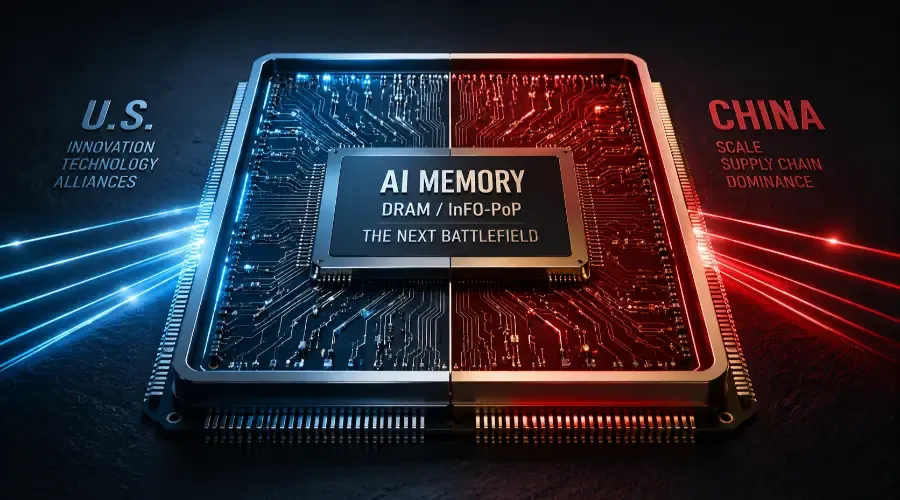
Apple has begun technical qualification of DRAM from ChangXin Memory Technologies (CXMT) – a state-backed Chinese maker on the Pentagon’s Section 1260H military-linked list – for devices sold in China.
The striking detail? CXMT’s chips aren't even cheaper. CXMT reportedly quoted prices comparable to or higher than Samsung and SK Hynix, declining to offer volume discounts. This is not a hunt for savings; it is a scramble for physical supply that has pulled Apple directly into the U.S.–China chip war.
What Is Actually Happening
Public reporting confirms Apple is running CXMT DRAM through technical validation across product lines, including iPhones and MacBooks. Simultaneously, Apple is lobbying Washington for regulatory clearance.
This comes amid mounting cost pressures – Apple has already raised select iPad and MacBook prices by $100–$300 – and Congressional pushback urging Apple to abandon CXMT. Yet Apple continues testing because traditional memory production is severely constrained.
Why Apple, and Why Now
Apple is the last company expected to court a politically radioactive supplier. To understand why it is walking into this political firestorm, consider the structural pressures:
- Extreme Political Exposure: Apple has the deepest pockets in tech and the most to lose from U.S. regulatory sanctions, making any Chinese supplier shift a high-stakes gamble.
- The YMTC Precedent: In 2022, Apple explored using NAND flash from China’s YMTC. U.S. government pressure forced Apple to abandon the plan before YMTC was formally added to the Commerce Entity List. Walking back toward that same risk proves the supply deficit is far worse today.
- HBM Cannibalization: The AI data-center boom has consumed global memory capacity. Leading producers are reallocating cleanroom space and wafers to High Bandwidth Memory (HBM) for AI accelerators, crowding out standard mobile LPDDR5/X DRAM.
The Hardware Bottleneck: InFO-PoP Packaging
The scarcity isn't just an abstract supply-demand mismatch – it is anchored in exact hardware engineering realities.
Modern mobile processors rely on TSMC’s Integrated Fan-Out Package-on-Package (InFO-PoP) technology. InFO-PoP stacks LPDDR5X DRAM dies directly on top of the mobile Application Processor (AP) using Through-InFO Vias (TIVs) to minimize board footprint and thermal throttling.
- Stranded Silicon: TSMC cannot complete back-end InFO-PoP assembly or ship finished SoCs without physical DRAM dies on-hand. Without memory delivery, front-end processed 2nm/3nm logic wafers sit stranded in TSMC’s fabs.
- Upstream Tool Bottlenecks: Equipment suppliers (ASML, Applied Materials, Lam Research, KLA) face 12+ month lead times due to their own sub-tier component shortages. Equipment vendors – not memory fabs – are the ultimate gatekeepers of capacity.
Even if Apple approves CXMT, CXMT's own ability to expand is capped by the exact same toolmaker delivery constraints.
Memory is therefore only one of several physical constraints that can limit AI and advanced computing deployment. Power, memory, advanced packaging, cooling and critical inputs form an interconnected bottleneck system, where solving one shortage can simply expose the next constraint further upstream.
Access Over Cost
The assumption that Apple is chasing cheap Chinese memory is incorrect. CXMT’s refusal to discount proves that physical access – not price – is the binding constraint. When a buyer with Apple’s purchasing power accepts higher prices from a blacklisted vendor, market scarcity has crossed from expensive to structurally unavailable.
The China Yield Curve Wildcard
While Apple scrambles for DRAM, China’s bond market signals domestic economic deceleration. The Chinese government bond (CGB) 10Y-1Y yield spread compressed to 50.71 bps in a classic "bull-flattening" pattern, ignoring a 450 billion yuan net drainage by the PBOC.
- Macro Tension: Weak domestic demand in China could free up CXMT DRAM capacity for export. However, this creates a sharp cross-asset contradiction: supply-driven cost inflation in hardware vs. demand-driven disinflation from China's slowing economy.
The Policy Contradiction
Washington is tightening export controls to isolate China’s semiconductor ecosystem, yet AI-driven memory shortages create economic necessity for U.S. firms to access Chinese capacity.
Laptop makers like HP and Acer are already using CXMT memory in non-U.S. devices. Meanwhile, CXMT’s blockbuster Shanghai IPO briefly made it China's most valuable listed semiconductor firm. The very scarcity U.S. policies created is legitimizing and funding the Chinese national champion policy aims to contain.
The same geopolitical tension is beginning to extend beyond semiconductors into the physical materials required to build the AI infrastructure around them. Tin and tungsten, among other specialized inputs, can become strategic constraints when computing demand rises faster than mining and processing capacity.
Institutional Actionability Matrix
| Entity / Sector | Institutional Implication | Actionable Exposure |
|---|---|---|
Tool Suppliers (ASML, AMAT, KLAC) |
Hold absolute pricing power as capacity gatekeepers | Long upstream equipment vs. downstream fabs |
Incumbent Memory (MU, Samsung, SK Hynix) |
Margin compression risk as CXMT validates 4th supplier capacity | Watch LPDDR5X spot-to-contract spreads |
| Consumer Tech OEMs | Hardware shipment delays due to stranded InFO-PoP inventory | Monitor lead-time delays on flagship mobile launches |
Falsification Framework
The thesis that memory scarcity forces reliance on Chinese suppliers weakens if:
- Tool Lead Times Compress: ASML or AMAT shorten lead times, enabling rapid incumbent capacity expansion.
- Policy Hard Stop: Washington explicitly bans U.S. OEMs from qualifying CXMT memory worldwide.
- HBM Demand Cools: AI accelerator demand moderates, allowing fabs to reallocate capacity back to mobile LPDDR5X.
Related Reading
• The Memory Shortage Behind the AI Boom: How HBM Demand Is Draining Conventional DRAM
• It's Not the Wafer Anymore: How Advanced Packaging Became the Binding Constraint on AI Chips
• Follow the Cargo: The AI Boom Is Hiding in Plain Sight in the U.S. Trade Deficit
Bottom Line: Apple’s CXMT test proves the memory shortage has evolved from a pricing issue into a geopolitical force. When physical constraints like InFO-PoP packaging and toolmaker lead times dictate supply, the scarce input doesn't just move prices – it bends global trade policy.
Disclaimer
BreakoutBulletin publishes educational and analytical content only. Nothing here is investment, financial, legal, or tax advice, or a recommendation or solicitation to buy, sell, or hold any security. Figures are drawn from The Trade Desk's Q2 2026 earnings release, SEC filings, and public reporting as of the publication date, and may be revised. References to analyst ratings or price targets are reported as facts and are not endorsements. Past performance does not indicate future results. Readers should conduct their own research and consult a qualified, registered financial adviser before making any decision.