
AI Infrastructure & Physical Constraints
By Manish T. · BreakoutBulletin
For most of computing history, memory got cheaper. A gigabyte of DRAM this year cost less than a gigabyte last year – reliably, for decades.
In 2026 that broke.
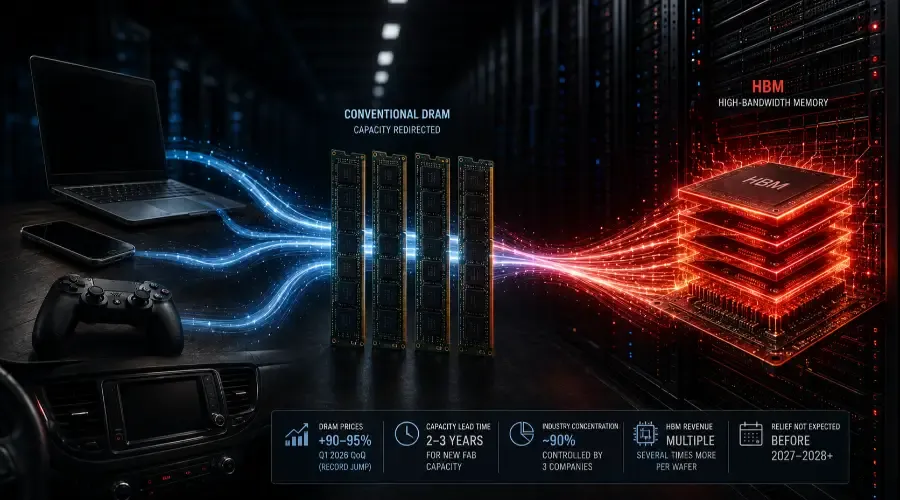
Conventional DRAM contract prices rose roughly 90–95% quarter-over-quarter in the first quarter, the largest single-quarter jump on record, and climbed another 58–63% in the second.
A standard 32GB DDR5 kit that sold for around $95 in mid-2025 was pushing $375 or more a year later.
The component that used to be an afterthought in a build is suddenly one of the most inflationary lines in the box.
The cause is not a factory fire or a collapse in PC demand – it is the AI build-out, reaching back down the supply chain and quietly draining the memory that everything else depends on.
The GPU and high-bandwidth-memory headlines are well covered.
What gets far less attention is where this squeeze lands next – in phones, laptops, game consoles and cars – and that spillover is the real story.
The Mechanism: Why AI Starves Conventional Memory
The squeeze is not a coincidence; it is arithmetic.
AI accelerators run on high-bandwidth memory (HBM), and HBM is far more lucrative to produce than the conventional DRAM in a laptop.
By industry estimates – including official comments from Micron's CEO – HBM consumes roughly three times the wafer area per gigabyte of standard DDR5, and memory makers earn several times more revenue per wafer - the wafer economics that drive the whole squeeze.
When fabrication capacity is finite – and it is – a rational manufacturer sends its wafers to the highest-margin product.
That is exactly what has happened: the same fabrication lines that make the RAM in a desktop are being redirected to make HBM for AI data centers.
The result is a structural shortfall in everything else.
Overall DRAM supply is growing only modestly this year – well below historical averages and far below what demand requires – because manufacturers are optimizing for HBM revenue rather than volume.
One industry description captures it bluntly – AI has cut off the "oxygen supply" to consumer-grade memory.
This is the key distinction from past memory cycles, which were driven by demand booms and busts; this one is a deliberate reallocation of capacity, which makes it stickier and far less likely to self-correct quickly.
Why It Won't Resolve Quickly
Two structural features make the shortage durable.
First, concentration: three companies – Samsung, SK Hynix and Micron – control roughly 90% of global DRAM production (Samsung at roughly 38%, SK Hynix at 29%, and Micron at 22%, according to Counterpoint Research).
That is an oligopoly, and when all three prioritize the same high-margin product, there is no fourth supplier to absorb the overflow.
It also hands those three unusual pricing power over the entire downstream electronics industry.
Second, the lead time to add capacity: a new DRAM fabrication line takes two to three years to build and qualify, and at current price differentials the incentive is to build HBM capacity, not conventional-DRAM capacity.
Most analysts see no meaningful relief before 2027–2028, and SK Hynix has warned the shortage could persist past 2030.
In the meantime, suppliers have moved key products to allocation and stretched lead times toward a year, while some have advised customers to plan for further monthly price increases through the end of the year.
NAND flash – the other half of the storage stack – is in a parallel squeeze, with much of 2026 production already contracted.
Where the Squeeze Actually Lands
This is the part the AI headlines skip.
The memory shortage does not stay in the data center – it flows straight into consumer and industrial hardware.
PC and laptop makers are absorbing DRAM costs that have doubled or more, so a mid-range build now carries a materially higher bill of materials than it did a year ago.
Smartphones, which rely on low-power DRAM from the same constrained lines, face the same input inflation.
The console and handheld market is seeing something almost without modern precedent: a hardware generation getting more expensive as it ages rather than cheaper, as manufacturers reprice to protect margins.
Automotive and industrial electronics – long-cycle products with little flexibility to swap components – sit squarely in the blast radius too, competing for the same scarce embedded memory.
For the companies that build these products, the shortage arrives as a fork: absorb the cost and compress margins, or pass it through and risk volume.
Neither is comfortable, and both eventually show up in earnings.
That is why a story usually filed under "PC hardware" is really a cross-sector margin story spanning consumer electronics, gaming and autos.
The Signal Is Already in the Numbers
This is not a forecast waiting to be tested – it has already begun surfacing in the largest companies' results.
In the most recent reporting round, Amazon raised its 2026 capital-expenditure plan, attributing the increase specifically to higher memory costs (as disclosed in its Q2 earnings call).
Apple, on the same week's call, said it had reluctantly raised prices on some products because memory costs had surged (as noted on its recent earnings conference call).
When two of the most powerful buyers in the world are absorbing or passing through memory inflation, the constraint is real, quantified, and already in the numbers.
The Structural Read
Step back and the shortage maps onto two forces at once.
It is a pricing-power story: the three memory makers hold rare leverage, and iin a capacity-constrained oligopoly that leverage tends to translate into margin and pricing durability for as long as the imbalance lasts.
It is also a margin-pressure story for everyone downstream – the OEMs in PCs, phones, consoles and autos who take memory as an input and cannot easily engineer around it.
And at the economy level it is a small cost-push inflation impulse: when a component that feeds a huge range of finished goods reprices this sharply, some of that cost ultimately reaches the shelf, which is one reason central banks have flagged supply shocks as a driver of sticky inflation this cycle.
None of this is a recommendation – it is a map of where a physical constraint redistributes pricing power and margin, which is a more durable question than any single quarter's move.
What Would Change the View
As with any structural read, it pays to name what would break it:
- A genuine moderation in AI demand – the kind that let memory makers redirect wafers back toward conventional DRAM – would loosen the constraint fastest.
- A sustained rollback in contract prices, rather than a one-month pause, would signal the peak had passed.
- New fabrication capacity arriving earlier than the 2027–2028 consensus would shorten the runway.
- Any primary signal that the three makers are re-prioritizing volume over HBM margin would undercut the thesis.
Absent those, the base case is a shortage that persists and continues to redistribute cost through the hardware chain – and these are the specific developments worth watching for the turn.
The Bigger Picture
The memory squeeze is a clean case study in a theme that will define this cycle: the AI build-out is increasingly bounded by physical constraints, not just by capital or chips.
Memory is one; power and grid access is another.
Each works the same way – a finite physical resource is reallocated toward the highest-value AI use, and the cost shows up somewhere less visible.
For readers, the transferable skill is to trace that chain: when a scarce input reprices, ask who holds the pricing power, who absorbs the margin hit, and where it eventually lands in a finished product.
the data-center headlines tell you where the demand is; the spillover tells you where the consequences are and that is usually the less-crowded place to be looking.
Related Reading
It's Not the Wafer Anymore: How Advanced Packaging Became the Binding Constraint on AI Chips → https://www.breakoutbulletin.com/article/advanced-packaging-ai-chip-bottleneck-cowos-tsmc
The AI Build-Out's Deepest Bottleneck Isn't Chips or Memory. It's Getting Power to the Building. → https://www.breakoutbulletin.com/article/ai-power-grid-bottleneck-transformers
Disclaimer
BreakoutBulletin publishes educational and analytical content only. Nothing here is investment, financial, legal, or tax advice, or a recommendation or solicitation to buy, sell, or hold any security. Industry and pricing figures reflect information available as of the publication date and are drawn from public sources (including memory-market trackers and company releases); figures may be revised. Past performance does not indicate future results. Readers should conduct their own research and consult a qualified, registered financial adviser before making any decision.