
Commodities & AI Infrastructure
By Manish T. · BreakoutBulletin
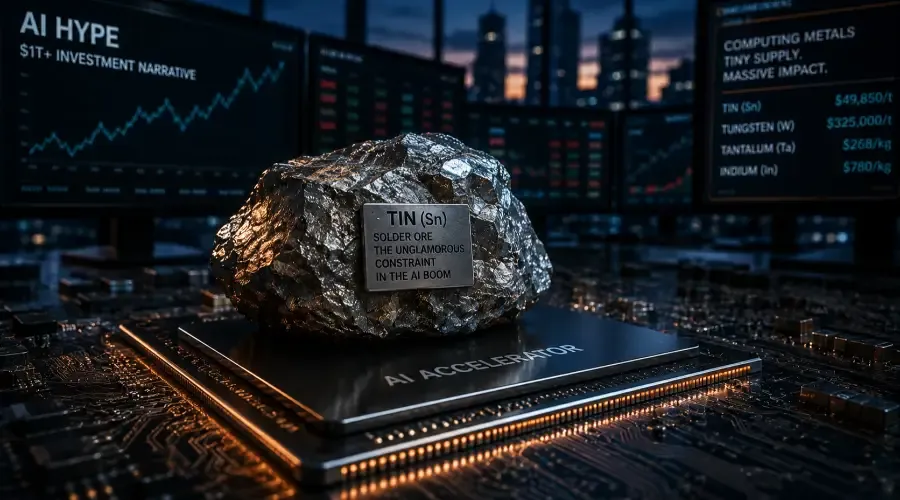
When people connect metals to the AI boom, they usually mean copper, the wiring that carries all that power. Copper is the well-covered part. The more interesting squeeze is happening one layer down, in a basket of obscure metals most investors have never traded: tin, tungsten, tantalum, and indium.
Some commodity desks now refer to these as “computing metals.” Each is physically consumed inside every server. Each is concentrated in a handful of mostly Chinese hands. And each has been quietly repricing as AI demand collides with thin supply and widening export controls. This is where the AI materials squeeze is really showing up, far from the copper headlines.
What They Do and Why Substitutes Don’t Exist
The uses are specific, and in most cases there is no practical replacement.
Tin is solder. Every connection on every circuit board and GPU interconnect is soldered. Solder consumes roughly half of the world’s refined tin. Tungsten, with an extreme melting point, wires the interconnects inside advanced chips; at leading-edge nodes, nothing else works. Tantalum goes into the capacitors that regulate GPU power delivery. Indium sits in the laser components inside the optical modules shuttling data between AI servers.
These are not peripheral inputs. They are in the solder, the interconnects, the capacitors, and the optics of essentially every AI system built. And as each new hardware generation packs in more density, it consumes more of them.
Prices Already Moved
This is not a forecast story. It is a repricing that has already happened.
Tin trades near multi-year highs around $50,000 a tonne, up more than 60% over the past year, driven by inelastic demand from data-center construction. Tungsten has spiked on Chinese export controls; according to Shanghai Metals Market, spot inventories for industrial buyers have fallen below fifteen days of supply. Tantalum ingot prices have risen more than 150% since late last year, per Asian Metal assessments. Indium is up roughly 60% since the start of the year, according to Fastmarkets.
A cluster of sleepy, low-growth commodity markets – long optimized for predictable demand from packaging and consumer electronics – has been hit all at once with a demand shock the supply chain was never built to absorb.
Why AI Is the Trigger
The common thread is the sheer physical scale of the build-out. Hyperscalers are on track to spend roughly $725 billion on AI infrastructure this year, up more than 70% from last year, according to Goldman Sachs, which projects that figure surpassing $1 trillion in 2027.
Every dollar of that spending builds physical hardware that consumes these metals. Unlike a chip design, you cannot engineer the tin out of a solder joint or the tungsten out of an interconnect.
Benchmark Mineral Intelligence projects that demand for tin from AI data centers alone will triple by the end of the decade. Drop a demand shock of that size onto commodity markets with thin project pipelines and little new refining capacity outside Asia, and structural deficits are the natural result. 2026 is expected to be a deficit year for several of these metals at once.
What the Cost Looks Like Inside a Server
To ground the numbers, consider a typical AI server motherboard. It contains roughly 15 grams of tin in its solder joints. At current prices, that tin costs about $0.75 per board, up from roughly $0.30 a year ago. A single server is not the point. A hyperscaler deploying tens of thousands of such servers sees these pennies compound into millions of dollars of incremental bill-of-materials inflation – and that’s just tin.
Tantalum and indium costs per server are harder to isolate but rising along the same curve. None of these line items are large enough to delay a build-out on their own, but together they form a quiet, persistent drag on hardware margins that was not present when commodity prices were flat.
More Than a Price Story: Concentration and Controls
What elevates this from a commodity squeeze to a strategic risk is the concentration of processing.
China controls an estimated 85–90% of global tungsten and indium refining capacity. In tin, it accounts for close to half of global smelting. Tantalum processing is somewhat more distributed – capacitor-grade powder capacity exists in the U.S., Germany, and Japan – but China remains the largest single supplier of refined tantalum products.
Beijing has been increasingly willing to use that leverage. Since 2023, it has rolled out a widening set of export controls: gallium and germanium first, then by late 2024 tungsten, indium, tellurium, bismuth, and molybdenum, with the tungsten regime tightened further in early 2026 through a licensing system that favors state-approved producers.
The consequence: the same materials the AI build-out depends on are now gated by export licenses and national-security policy. That turns scarcity into something harder to manage – not just expensive metal, but metal whose availability is a geopolitical lever.
Speculative Froth and Recycling Buffers
A fair read has to flag two offsets.
First, speculation. The International Tin Association has noted that investor activity, particularly from China, has driven tin prices beyond what fundamentals alone justify. Net speculative long positions on SHFE tin futures have climbed sharply, and elevated prices are already dampening some downstream buying, trimming near-term demand forecasts. Short-term corrections are entirely possible.
Second, recycling and stockpiles. Tin has a well-established recycling chain from solder dross and scrap electronics, which provides a partial buffer. Indium recycling from ITO targets is also growing. Tungsten and tantalum recycling from electronics remains limited, however, meaning those markets are more exposed to primary-supply disruptions.
So the honest read is not that these prices only rise. It is that the structural driver – AI’s physical demand meeting concentrated and increasingly export-controlled supply – is durable even when the prices are volatile around it. The signposts worth watching are whether the deficits and the concentration persist as the speculative froth comes and goes.
The Bigger Picture
This is the raw-commodity floor of the AI hardware stack. Above it sit the specialized materials in the substrates, the power chips, the memory, and the packaging – each a concentrated bottleneck the boom has bid up, and each a constraint on how fast and how cheaply AI can be built.
Computing metals are simply the deepest layer of that same story: unglamorous, concentrated, physically consumed, and quietly repricing while the market’s attention stays fixed on the GPU and, at most, on copper.
The AI boom is usually measured in compute and capital spending, but its physical footprint reaches all the way down into the power grid and the periodic table – into metals most investors have never thought about. The constraint that matters is rarely the visible one. This time, one of them is the solder.
Related Reading
Follow the Cargo: The AI Boom Is Hiding in Plain Sight in the U.S. Trade Deficit
It's Not the Wafer Anymore: How Advanced Packaging Became the Binding Constraint on AI Chips
The AI Build-Out's Deepest Bottleneck Isn't Chips or Memory. It's Getting Power to the Building.
Disclaimer
BreakoutBulletin publishes educational and analytical content only. Nothing here is investment, financial, legal, or tax advice, or a recommendation or solicitation to buy, sell, or hold any security or commodity. Price, supply, and demand figures are drawn from public sources (including Shanghai Metals Market, Fastmarkets, Asian Metal, Goldman Sachs, Benchmark Mineral Intelligence, and International Tin Association reports) available as of the publication date, and may be revised. Commodity prices are volatile. Past performance does not indicate future results. Readers should conduct their own research and consult a qualified, registered financial adviser before making any decision.