
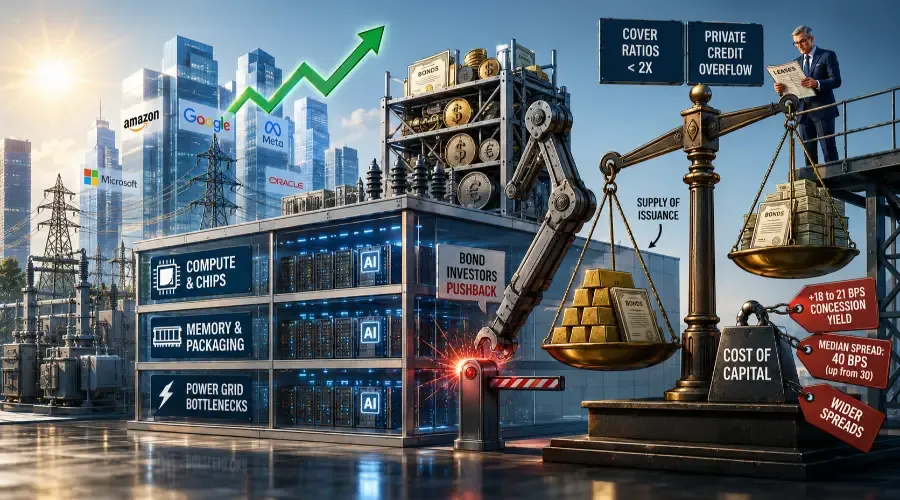
The equity market still treats AI capex as a growth engine. The credit market is starting to treat it as a cost that has to be priced—and that gap is the story worth watching now.
By Manish T. · BreakoutBulletin
For two years, the AI story has been an equity story. A company announces enormous capital spending on data centers and chips, and its stock goes up, because the market reads that spending as proof of future growth. But the more revealing signal has quietly moved somewhere else: the bond market.
The biggest AI builders have become some of the largest corporate borrowers on the planet, and the investors who lend to them are starting to ask for more in return. Where the stock market treats AI capital spending as a growth engine, the credit market is beginning to treat it as a cost that has to be priced. That gap–between how equity and debt investors see the same spending–is the story worth watching now.
The Scale of the Borrowing
The numbers are what make this a market event rather than a footnote.
Amazon, Alphabet, Meta, and Oracle issued roughly $194 billion of bonds through early July 2026, according to a Reuters analysis of LSEG data–up about 79% from around $108 billion in all of 2025. Including Microsoft, Goldman Sachs expects the five largest hyperscalers to sell close to $250 billion of bonds this year and around $400 billion in 2027. The tech sector now accounts for 20% of U.S. dollar investment-grade issuance–an all-time high.
Individual deals have reached a scale rarely seen in corporate debt:
Nvidia sold $25 billion of bonds in June–its first debt offering since 2021–attracting $85 billion in demand, more than three times the offering size. The deal was upsized from an initial $20 billion target.
Amazon followed with an eight-tranche, $25 billion offering in July, bringing its total debt issued this year to $92 billion–surpassing Alphabet, Meta, and Oracle individually.
Meta raised its 2026 capex guidance to $125–145 billion and issued $55 billion in debt over six months.
Debt now funds roughly a third of these companies' capital spending–a meaningful shift for firms that historically built from cash flow. AI infrastructure is no longer just an equity narrative. It has become a core trade in the credit market.
The Debt-to-Capex Picture, by Company
| Company | 2026E Capex | Debt-Funded Portion | Implied Debt Burden |
|---|---|---|---|
| Alphabet | ~$180B | ~15% | ~$27B |
| Oracle | ~$50B | ~50% | ~$25B |
| Meta | ~$125–145B | ~40–45% | ~$55B |
| Amazon | ~$200B | ~? | $92B YTD |
| Microsoft | ~? | ~? | Included in $250B group estimate |
Sources: Company guidance, Goldman Sachs research, Reuters/LSEG data
Alphabet has been the most conservative, debt-financing only about 15% of its $180 billion capex plan. Oracle, by contrast, has financed roughly 50% of its $50 billion plan. Meta's $55 billion debt issuance against $125–145 billion in capex implies a ~40–45% debt-funded ratio.
What the Lenders Are Signalling
Here is the tell. As the supply of these bonds has surged, the price of that borrowing has crept up.
For Amazon, Alphabet, Meta, and Oracle:
- The median spread on 2-to-4-year bonds rose to about 40 basis points from 30 a year earlier
- On 5-to-7-year debt, to 60 from 50
- On bonds maturing beyond 20 years, to 118 from roughly 108
- Concession yields–the extra yield issuers offer to get deals done–jumped from about 2 basis points in 2025 to around 12 in 2026.
When Amazon brought its "surprise" $25 billion sale on July 7, it had to sweeten the longest-dated portion with an extra 18 to 21 basis points of yield. The July offering drew $62 billion in peak demand–still 2.5x oversubscribed, but notably weaker than the $37 billion March offering that attracted 3.2x demand. The order coverage ratio for hyperscaler bonds has dropped from nearly 5x in February to less than 2x in July.
Investors, in the words of Bank of America's note, are "pushing back". Some are turning to credit-default swaps to hedge AI-related risk directly.
How It Actually Works, and What It Doesn't Mean
It is worth being precise about the mechanism, because the easy interpretation is the wrong one.
Wider spreads can mean two different things:
- A supply-and-absorption effect: flood any market with a huge volume of new bonds and buyers will demand a little more yield to soak it all up, regardless of the borrower's health.
- A genuine credit-risk effect: investors judging the borrower riskier and charging accordingly.
Right now, the evidence points mostly to the first. The tech sector's credit spreads have widened relative to the broader investment-grade index–reversing the 2010–2025 trend where tech spreads traded tighter than the broader market. As Goldman Sachs notes, the widening is driven by record-high issuance concentration, not deteriorating fundamentals.
For context: the ICE BofA U.S. Corporate Index option-adjusted spread stood at 77 basis points as of mid-May 2026–well inside the 10-year average near 130 basis points. We are not in distressed territory; we are simply moving off the tightest levels in 25 years.
These are investment-grade companies with enormous cash flows. Across the group, projected capital spending of roughly $750 billion this year is nearly matched by operating cash flow of about $778 billion. This is not a credit crisis or a funding wall. What it is, more precisely, is the cost of AI growth repricing in real time.
The Equity Issuance Counterpart: It's Not Just Debt
Hyperscalers are tapping all funding sources–not just bonds.
In June 2026, Alphabet priced and upsized an $84.75 billion equity capital raise–the largest equity capital raise in U.S. corporate history. The deal was upsized from $80 billion after demand outstripped the original terms. Alphabet also announced a concurrent $40 billion at-the-market offering program.
Oracle is planning $40 billion of combined debt and equity for fiscal year 2027.
The equity raises are a signal that debt markets alone cannot absorb the full burden of the AI buildout. Companies are layering equity on top of debt to preserve balance-sheet flexibility–a sign of prudence, but also a sign that the public bond market is reaching its near-term absorption limit.
The Private Debt Channel: Where the Overflow Is Going
Public bond markets are not the only game in town. Private debt and project finance structures have absorbed over $140 billion of data center financing since the start of 2026.
As Goldman Sachs credit strategist Amanda Lynam notes, private debt and project finance will play an increasingly important role in filling the funding gap after 2027. Mizuho expects funding for data center projects to land between $210 billion and $235 billion in 2026–approximately four times the high-water mark for LNG project finance volumes.
This is the overflow valve. As public bond spreads widen and order books cool, private credit is stepping in–at higher yields, with bespoke covenants, and with less transparency. The risk is that mispriced private credit eventually flows back to haunt the public markets.
Why It Matters: Discipline Arrives Through Credit First
The significance is about who imposes discipline, and when.
Capital markets are starting to price the AI buildout more carefully before public equity does. If spreads keep widening, the cheapest path of the last two years–issue more debt and keep building–gets steadily more expensive. At some point, management teams face a real trade-off between preserving balance-sheet flexibility and sustaining the growth rate of their infrastructure.
That is a different regime from the recent past, when investors treated capital spending almost as a reflex worth rewarding. The deeper shift is one of framing: the AI trade slowly re-rating in investors' minds from an unbounded growth option toward a capital-intensive industrial cycle, one that has to prove its spending actually earns a return rather than just generating headlines.
The Financial Layer on Top of the Physical Ones
This also connects to two threads running through the whole AI build-out:
- Rates: the sheer size of this borrowing has been large enough to help push long-end Treasury yields higher, feeding directly into the higher-for-longer backdrop the rest of the market is already wrestling with.
- Physical constraints: the memory shortage, advanced-packaging limits, and power-grid bottlenecks all describe things the AI buildout physically cannot get fast enough.
This is the financial version of the same story: even the money to pay for that physical capacity is now repricing. Chips, memory, and power are constraints on what can be built. The cost of capital is the constraint that prices all of them.
Who Feels It – and How
None of this is a call on any security, but the structural effects are worth naming.
| Stakeholder | Position | Primary Impact |
|---|---|---|
| Hyperscalers (AMZN, GOOGL, MSFT, META, ORCL) | The borrowers | Rising cost of capital; shifting mix toward equity and private debt |
| Bond investors | The lenders | More supply, slightly wider spreads; forced to carry more AI exposure in IG indices |
| Data center landlords / infrastructure providers | The beneficiaries | If self-building gets more expensive, hyperscalers may lease capacity instead |
| Highly leveraged AI startups | The losers | Depend on cheap debt; first to get crowded out as capital costs rise |
| Passive bond fund holders | The unaware | Hyperscalers are becoming a larger share of IG indices–concentration risk rising |
If financing grows scarcer or costlier, hyperscalers may lean more on contracted infrastructure than on self-building everything, which tends to favour providers of that capacity: data-center landlords, power and grid equipment, cooling, and networking.
There is also a quieter effect: as hyperscalers become some of the largest issuers in investment-grade indices, any fund that tracks those indices is now carrying more concentrated exposure to a single theme than it may realise.
What Would Change This Read
Because this is largely a supply story, it can also normalise like one.
The reading weakens if:
- The market absorbs the wave of issuance and spreads stabilise or tighten
- Hyperscaler cash flows keep running ahead of capital spending
- The Fed eases, lowering the base cost of all borrowing
The reading hardens if:
- Cover ratios keep falling
- A ratings agency puts a major issuer on review
- Doubts about AI returns harden–turning the supply story into a credit story
A specific signal to watch: the ICE BofA U.S. Corporate Index spread. At 77bps, it remains well below the 10-year average of 130bps. If it crosses 100bps–still historically tight–that would signal that the widening is more than just a supply-and-absorption effect. If it pushes toward 150bps, we are in a different regime entirely.
The Bigger Picture
The constraints on the AI boom have been migrating steadily: from compute to memory to packaging to power, and now to the cost of funding all of it.
Each layer is a different way of asking the same question the market has mostly avoided: does this spending earn its keep? The bond market, characteristically, is asking it first and most bluntly, by charging more.
That does not mean the AI build-out stops. It means the era of financing it as a costless reflex is ending, and the next phase will be judged less on ambition than on returns.
For anyone trying to read this cycle, the lesson is simple: watch the bond market, not just the stock. It tends to notice the bill before the equity market does.
Related Reading
The Memory Shortage Behind the AI Boom → https://www.breakoutbulletin.com/article/ai-memory-shortage-hbm-dram-spillover-analysis
It's Not the Wafer Anymore (Advanced Packaging) → https://www.breakoutbulletin.com/article/advanced-packaging-ai-chip-bottleneck-cowos-tsmc
Getting Power to the Building (Power) → https://www.breakoutbulletin.com/article/ai-power-grid-bottleneck-transformers
AI Compute Is Quietly Turning Into a Utility Business (Leases) → https://www.breakoutbulletin.com/article/ai-boom-15-year-data-center-leases
Disclaimer
BreakoutBulletin publishes educational and analytical content only. Nothing here is investment, financial, legal, or tax advice, or a recommendation or solicitation to buy, sell, or hold any security. Bond-market, issuance, and spread figures reflect information available as of the publication date and are drawn from public sources (including Reuters/LSEG data, SEC filings, and bank research); figures may be revised. Past performance does not indicate future results. Readers should conduct their own research and consult a qualified, registered financial adviser before making any decision.
Data Sources
Reuters/LSEG – Hyperscaler bond issuance data (July 2026)
Goldman Sachs – Hyperscaler issuance projections ($250B 2026, $400B 2027)
Goldman Sachs – Tech sector share of IG issuance (20%) and spread widening analysis
Reuters – Nvidia $25B bond offering (June 2026)
Nasdaq / Reuters – Amazon $25B July offering, $62B demand
Yahoo Finance / Fortune – Amazon concession yields (18–21bps)
SEC Form FWP – Alphabet $84.75B equity raise filing
Goldman Sachs – Private debt/data center financing ($140B+)
ICE BofA U.S. Corporate Index – 77bps spread (May 2026)
Reuters – Meta $55B debt issuance, $125–145B capex
Reuters – Alphabet 15% debt-funded capex, Oracle 50%
Apollo – Order coverage ratio drop (5x→<2x)