
| Company | Tenant | Capacity | Term | Base Value | Structure |
|---|---|---|---|---|---|
| Hut 8 Beacon Point | Undisclosed IG | 704 MW | 15 yrs | $19.6B | Triple-net, 3% escalator |
| Hut 8 Portfolio | Multiple IG | 949 MW | 15 yrs | $26.6B | Triple-net, 3% escalator |
| Core Scientific-AMD | AMD + Neocloud | 530 MW | 15 yrs | $14B+ | Colocation, warrants |
| TeraWulf-Anthropic | Anthropic | 401 MW | 20 yrs | ~$19B | Purpose-built campus |
| Cipher Mining-AWS | Amazon Web Services | 300 MW | 15 yrs | $5.5B | Turnkey space + power |
| CleanSpark | Undisclosed IG | 175 MW | 20 yrs | $6.6B | Triple-net |
Sources: Company disclosures
TeraWulf signed a 20-year, ~$19 billion lease with Anthropic for 401 MW at its Kentucky campus, with initial capacity expected online in the second half of 2027. Cipher Mining secured a 15-year, $5.5 billion lease with Amazon Web Services for 300 MW. CleanSpark executed a 20-year, $6.6 billion triple-net lease for 175 MW with a high-investment-grade global technology company.
Listed Bitcoin miners are now collectively pursuing more than $70 billion in AI data center contracts.
Why This Is a Utility, Not a Bet
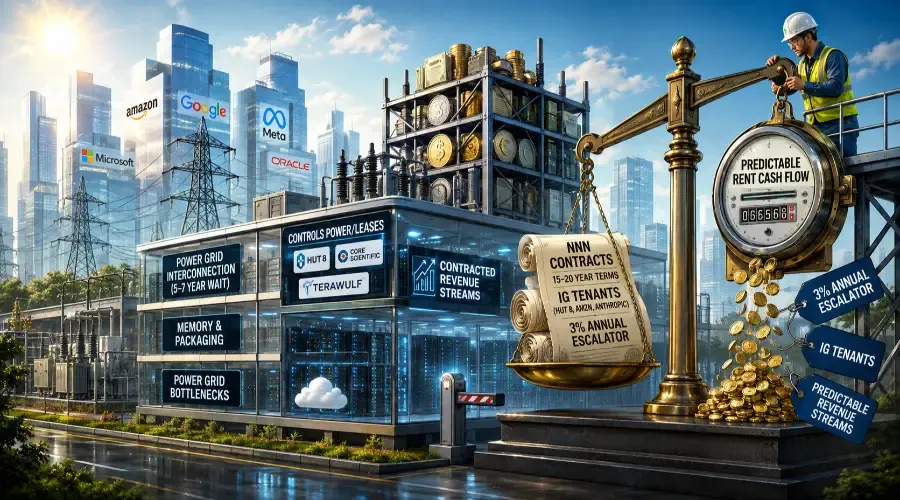
The structure of these leases is what changes the nature of the asset. Both Hut 8 leases are triple-net (NNN), meaning the tenant covers operating costs including real estate taxes, insurance, and maintenance. They carry annual rent escalators–in Hut 8's case, about 3% a year. They run for 15 years, and the tenants are investment-grade companies.
What makes an asset "utility-like":
- Predictable revenue: long-term contracts with known terms
- Creditworthy counterparties: investment-grade tenants
- Escalating cash flows: annual rent increases baked in
- Scarcity value: the asset cannot be easily replicated
- Contracted returns: returns are defined by contract, not market volatility
Put those features together and the economics stop resembling a venture bet and start resembling a toll road or a regulated utility: a booked stream of rent-like cash flows, escalating on a schedule, backed by a scarce physical asset and a creditworthy payer. Needham analyst John Todaro said the Hut 8 leases offer "among the strongest colocation economics signed in 2026".
That is a fundamentally different thing to value than a concept. Investors are no longer underwriting whether AI demand shows up; they are underwriting a contract. And a contract with a known tenant, a known term, and a known escalator can be modeled, financed, and priced the way infrastructure is.
The Bitcoin Miners Became the Landlords
Here is the part that gets missed. The companies executing these deals–Hut 8, Core Scientific, TeraWulf, Cipher Mining, CleanSpark–are former or current Bitcoin miners.
That is not a coincidence; it is the whole point. What suddenly became the scarcest resource in AI is exactly what a crypto miner already owned: power-rich sites with secured grid interconnections, engineered from the start for enormous, continuous electrical loads. A traditional mining facility ran on 5 to 20 megawatts per site. A single modern AI data-center building can need 50 to 100 megawatts.
The miners had already fought the multi-year battles for interconnection and utility capacity that a newcomer now cannot win quickly. Morgan Stanley estimates that U.S. data center developers could still face power shortages through 2028 even if all major Bitcoin mining sites are repurposed for AI workloads. The brokerage projects a U.S. power shortfall of 38 gigawatts by 2028, with grid interconnection wait times in some regions stretching 5 to 7 years.
When AI demand arrived looking for a place to plug in, these companies were holding the one asset in short supply. Core Scientific went from its first AI colocation deal to operating hundreds of megawatts of billable AI capacity in under two years. AI colocation now makes up the large majority of its revenue. The crypto downturn, in an odd way, seeded a bench of ready-made AI landlords.
The Cost to Build: Not Free Money
The utility model still carries construction and financing risk. Hut 8 financed Phase 1 of Beacon Point with senior secured notes. Needham estimates construction will cost approximately $3.5 billion, based on capital spending of $9 million to $11 million per critical megawatt, with about 85% financed through additional debt. Core Scientific recorded a $1.15 billion GAAP net loss for Q2, though this was primarily driven by non-cash fair value adjustments on outstanding warrants following stock price appreciation, while adjusted EBITDA remained healthy at $41.1 million.
These contracts convert to cash only if the capacity gets energized on schedule, which depends on the same long-lead electrical equipment–transformers and switchgear–that is constraining the entire sector.
The Market Is Paying Attention–and Being Disciplined
The market reaction to these deals reveals how investors are parsing the fine print.
Hut 8 shares rose 10.37% on the day of its second Beacon Point lease announcement. Needham raised its price target to $145 from $128.
TeraWulf shares rose more than 10% on its Anthropic lease announcement.
CleanSpark shares rose almost 9% on its $6.6 billion lease announcement.
Core Scientific, however, fell about 3% on its AMD deal announcement.
Why the divergence? Investors looked past Core Scientific's headline $14 billion number to the fine print: AMD received warrants for up to 30 million shares at $23.47, raising the prospect of dilution, and a meaningful slice of the capacity sits with Neocloud–an indirect, AMD-backed cloud tenant–rather than AMD itself, a weaker credit than the headline implies.
That is the discipline this asset class invites. Long-duration leases are only as good as the counterparties behind them and the developer's ability to actually build. This reading weakens if counterparty quality proves shakier than the contracts suggest, if dilution outweighs the revenue, or if construction slips. At that point the utility framing gives way to ordinary project risk.
What It Means for How the Trade Is Priced
This reframes where value sits. In the first phase of the AI trade, exposure was the whole game, and any company that could credibly claim to touch AI demand was rewarded. In this phase, the market increasingly separates the companies that control power, interconnection, and signed leases from those that merely advertise exposure.
AI-infrastructure equity starts to trade on capacity utilization, contract tenor, and counterparty quality rather than narrative momentum. And the scarcity compounds: every gigawatt absorbed into a 15-year lease is a gigawatt a newcomer cannot obtain on similar terms, which makes the sites and interconnections already under contract more valuable, not less. In infrastructure, scarcity itself becomes the moat.
The Power Scarcity, by the Numbers
Morgan Stanley's 120-page AI infrastructure report identifies "Time to Power" as the most underestimated investment theme in AI data centers. The numbers are stark:
- 38-gigawatt U.S. power supply gap projected by 2028
- Grid interconnection wait times of 5 to 7 years in some regions
- Even repurposing all major Bitcoin mining sites won't close the gap
This is the business-model consequence of a physical limit. The AI build-out is bounded by things it cannot get fast enough, from memory and chips to the power grid itself. When a resource is that scarce, whoever controls it can lock it into long, escalating contracts, and the constraint becomes a cash flow. That is why the same higher-for-longer, scarce-capital macro backdrop that makes financing expensive also makes contracted, investment-grade-backed infrastructure more attractive to own. Power scarcity is the problem in one frame and the moat in another. The leases are simply where the two frames meet.
Who Feels It and How
None of this is a call on any security, but the structural tilt is clear.
The shift tends to favour whoever controls the scarce inputs: operators of power-rich campuses and powered shells, the former miners now repositioning as energy-and-infrastructure platforms, data-center landlords, and the grid-equipment, cooling, and electrical-construction suppliers who build the sites.
The pressure tends to fall on the opposite profile: the asset-light names whose AI exposure is a claim rather than a controlled resource, and the speculative cloud providers without durable utility access or investment-grade backing.
For anyone reading these companies, the useful questions have shifted from "how much AI exposure" to "how much contracted capacity, on what terms, backed by whom, and can it actually be built?"
What This Means for Valuation
The piece makes a compelling case that AI compute is becoming a utility business. If compute is becoming a utility, what does that mean for valuation multiples?
Utilities trade at ~15–20x earnings with high dividend yields. AI infrastructure companies are currently trading at tech multiples (30–50x+). If the market fully reprices these assets as utilities, there is significant multiple compression risk–even if the underlying cash flows are stable.
The market is already starting to separate the companies that control power, interconnection, and signed leases from those that merely advertise exposure. The discipline this asset class invites means that valuation will increasingly reflect execution risk–can the capacity actually be delivered on time and on budget?–and counterparty quality, not just the headline contract value.
For investors, the opportunity lies in identifying which companies can actually execute on these massive buildouts–and which will see their utility-like cash flows weighed down by construction delays, cost overruns, and dilution. The utility framing is durable, but the path to those cash flows is anything but guaranteed.
The Bigger Picture
The AI trade is maturing from an arms race into an industrial cycle, and industrial cycles are won by whoever controls the scarce physical input and can lock it into long contracts. The leases are the clearest sign of that transition yet.
When compute capacity becomes a 15-year, investment-grade-backed, escalating cash flow, you are no longer looking at a story stock; you are looking at infrastructure, with all the durability and all the plodding execution risk that word implies. The habit worth building is to read the contracts rather than the headlines: the tenant, the term, the escalator, the interconnection, and whether the megawatts can actually be delivered. That is where the real economics of the AI boom are now being written.
Related Reading
The Memory Shortage Behind the AI Boom → https://www.breakoutbulletin.com/article/ai-memory-shortage-hbm-dram-spillover-analysis
Getting Power to the Building (Power) → https://www.breakoutbulletin.com/article/ai-power-grid-bottleneck-transformers
The AI Boom Is Now Running on Debt (Credit) → https://www.breakoutbulletin.com/article/ai-boom-debt-bond-market-repricin
Disclaimer
BreakoutBulletin publishes educational and analytical content only. Nothing here is investment, financial, legal, or tax advice, or a recommendation or solicitation to buy, sell, or hold any security. Lease, capacity, and contract figures reflect company disclosures and public reporting available as of the publication date; figures may be revised. Past performance does not indicate future results. Readers should conduct their own research and consult a qualified, registered financial adviser before making any decision.
Data Sources
Hut 8 Corp. Press Release – Beacon Point Second Lease (July 20, 2026)
Needham & Company – Hut 8 Price Target Raise (July 22, 2026)
Core Scientific Q2 2026 Earnings – Colocation Revenue
Core Scientific-AMD Infrastructure Partnership
Reuters – TeraWulf-Anthropic Lease (July 6, 2026)
Nasdaq – CleanSpark $6.6B AI Lease (July 15, 2026)
Cipher Mining – AWS Lease ($5.5B, 300 MW)
Morgan Stanley AI Infrastructure Report – 38 GW Power Gap
Morgan Stanley – Power Shortages Through 2028